Haven't Done This in a While…

Yes, Pun Daughter and I went to Fenway Park last night to see the Red Sox play the Washington Nationals. The Sox won, too: 6-3! They currently have a five-game win streak. Although they are currently in last place in the AL East, they are only a half game back of Baltimore. So watch out, Birds.

We got invited to the game by the Dana-Farber Cancer Institute (DFCI), thanks to the "Qualified Charitable Contribution" (QCD) I made to them at the end of last year. There were tax advantages: basically, DFCI gets a hunk of cash, a large fraction of which would have otherwise gone to Uncle Stupid's coffers.

Which makes it, pretty much, the most expensive Red Sox tickets—or any tickets, for that matter—that I've ever purchased. But I also got that cap, and there was a buffet with hot dogs. (Parking? Let's just say it cost more than a month's NESN 360 subscription.)

I should also point out that a few weeks after I made the QCD, DFCI made the news in an unpleasant way: Dana-Farber settles Justice Department suit over manipulated data.

The Dana-Farber Cancer Institute, one of the nation’s premier cancer research and treatment centers, is paying $15 million to settle a lawsuit claiming that some of its top researchers authored papers containing manipulated data.

In its settlement with the Department of Justice, Dana-Farber admitted that scientists working under the supervision of one of its principal investigators used federal grant dollars to conduct research that led to papers with duplicated or manipulated images. In these cases, the Boston-based cancer center acknowledged, a scientist identified in the settlement as “Researcher 1” did not adequately supervise lab members.

Now my QCD was (to me) a lot of money. But it was (frankly) negligible compared to $15 million. And (worse) since money is fungible, the QCD cash I avoided sending to Uncle Stupid… effectively went to Uncle Stupid anyway.

Live and learn, I guess.

But the game? Ah, well, the "free" DFCI seats were in Grandstand 7, Row 12, out in left field by Pesky's Pole. This is not a complaint, just an observation: in their quest to pack as many fans as possible into the "lyric little bandbox of a ballpark.", I think the seats were designed for the typical 1912 human frame: short and skinny, probably still recovering from the Irish Potato Famine. Bottom line for me: uncomfortable lack of knee- and ass-space.

And (again, not complaining, just observing) the sightlines were … not the best. Vertical girders supporting the upper decks, and the upper deck itself blocked my view of basepaths (which were pretty far away anyway), the scoreboard, and most of the big screen above center field. (The Stadium Insider ranks Grandstand 7 among its "least favorite seats" at Fenway.)

And I didn't find out until this morning when I read the news: Willson Contreras, hitting a homer in the first inning that put the Red Sox in a 3-1 lead… got ejected in the second inning after appearing to protest an umpire's check-swing call. I was there, totally missed that.

Still, I had fun. I haven't decided on my QCDs for 2026 yet ("Let your portfolio grow tax-advantaged," my Fidelity guy advised.) So I could be back in 2027!

Also of note:

  • "Well, there's spam egg sausage and spam, that's not got much spam in it." WSJ columnist Gerard Baker doesn't like the options on his political menu: America Is the Land of Endless Choice, Except in Politics. (WSJ gifted link) Good observations all the way through, skipping to his bottom line:

    Few things could induce me to vote for another four years of the sort of Republicanism we are enduring now. But one of them is definitely the alternative of Islamist-friendly, open-the-borders, defund-the-police, kill-the-billionaires socialists running the country. Out of America’s vast diversity we are somehow at risk of narrowing our choice to that between a rampantly corrupt, inept, ideologically and practically capricious personality cult of a party and a party of graduate student activists with terrorist sympathies and ideas about economics that were discredited half a century ago.

    There’s no prospect of a third-party breakthrough. But if I can live in a country where I can have my steak done medium-rare and washed down with a glass of a liquid that is one-third soy, one-third oat and one-third half and half, why can’t I choose a government that is sane, honest, patriotic, responsible and worthy of the people it governs?

    I will (once again) point out my modest crackpt proposal which would fix everything bad about everything.

  • Well, except for Maggie Goodlander. Arnold Kling notes one party enthusiastically driving down the Road to Serfdom: The Democrats *are* the DSA.

    An ordinary political organization makes compromises. A revolutionary faction makes demands. An ordinary political organization will trade victories on some issues for losses on others. A revolutionary faction drives for victories everywhere. An ordinary political organization, once it is in power, accepts that eventually it will no longer be in power. A revolutionary faction, once it is in power, resorts to violence and terror to remain there.

    It is likely that DSA’s revolutionary goals are not shared by most Democrats, much less most Americans. But do not underestimate the effectiveness of revolutionary parties. Sometimes they win, as sheer determination and discipline overcomes minority status. The Bolsheviks won. The Nazis won. The Viet Cong won. The Islamic Revolution in Iran won.

    I hope that it can’t happen here.

    Have a nice day.

    "Have a nice day?" Sorry, Arnold, I have other plans.

  • Who could blame them? Jim Geraghty's WaPo column observes: Not all states could stomach Trump’s Great American State Fair. (WaPo gifted link) He notes that many states declined to participate at what looks like a Soviet-style celebration of the Great Leader:

    Trump spoke at the fair’s opening ceremony last Wednesday night, serving up the usual tedious bellyaching (“As you know very well, a short time ago we were a dead country. We were dead”) and inaccurate boasting, as in, “Oil prices are plummeting downward today. It hit a new low, and the world is a much safer place.” Whether measured by the national average cost of gasoline or global crude oil, prices are down slightly from last month, not hitting “a new low.”

    Trump is incapable of just saying, “We should be so thankful for all we have inherited, God bless America,” and getting off the stage.

    If he couldn’t do it last week at the fair, he certainly won’t this weekend. As Trump posted online: “On July Fourth, at The Lincoln Memorial and Washington Monument, in beautiful and safe Washington D.C., we are going to host the most spectacular TRUMP RALLY of them all, a ‘TRIBUTE TO AMERICA.’”

    But as NHJournal reports, NH will be represented: America 250? New England Says No Thanks; NH Says ‘Live Free or Die’.

    As America marks 250 years since the Declaration of Independence, New Hampshire is standing alone in New England at the Great American State Fair in Washington, D.C.

    The 16-day America 250 celebration opened on the National Mall on June 25 and runs through July 10. Organizers describe it as a World’s Fair-style showcase of states, territories, civic groups, businesses, and American culture.

    But while the Granite State is showing up, its New England neighbors are sitting it out.

    Massachusetts, Maine, Vermont, Connecticut, and Rhode Island all declined to send official state agency representatives to the event, leaving New Hampshire the only New England state to take part. And they are not alone. Other states opting out include Illinois, Oregon, Washington, Pennsylvania, and North Carolina.

    I went to the National Mall for the Bicentennial shindig in 1976. Spectacular! And (arguably) the US was in much worse shape, politically and economically, back then.
I Also Do Not Approve This Message

Saul's back, but he seems to have lost Mike's support:

Don't be misdirected!:

  • Many a tear has to fall. The NR editorialists point out a likely, if not inevitable, outcome: Zohran Mamdani's Rent Freeze Will Hurt Renters and the City.

    By a 7–1 majority, New York City’s euphemistically named Rent Guidelines Board approved freezing rents in both one- and (this has never occurred before) two-year leases on Gotham’s million or so rent-stabilized apartments. Mayor Zohran Mamdani can now boast that he has delivered on a key campaign promise. A member of the board picked to represent the interests of property owners — after all, that is who landlords are — resigned ahead of the vote. The board, she said, had “stopped being a fact-finding body” and had been rebuilt “to deliver a rent freeze.” Operating behind the hollowed-out façades of more legitimate structures is something the hard left likes to do.

    The result was a win for Mamdani, but it will be a loss for the city over which he presides. The disastrous consequences of rent control have been known for a very long time. In 1971, the Swedish economist Assar Lindbeck, then a member of his country’s center-left Social Democratic Party, described it as “the most efficient technique presently known to destroy a city — except for bombing,” and he was far from the first to come to a similar conclusion. A rent freeze is rent control on steroids.

    Jonah Goldberg had an excellent response to "Writer, author, columnist, recovering lawyer, and yogi" Jill Filipovic, who says hey, why not:

  • "I really have mixed feelings about this." That's one of my favorite lines from Play it Again, Sam, spoken by Woody Allen. Funny, because it's about the best outcome Woody's character has come to expect.

    And it came to mind when reading the WSJ editorial: Only a Few Democrats Fight Back Against the Socialists. (WSJ gifted link)

    The election success of the Democratic Socialists of America (DSA) is alarming many mainstream Democrats, but the striking news is how few elected officials have so far been willing to speak up against the DSA’s radical beliefs.

    […]

    The limited good news is that a few Democrats are fighting back, led by Long Island Rep. Tom Suozzi. He and nine other House Democrats have signed what they call “The Promise to America” that explicitly rejects the radical left’s agenda. Five House Democratic candidates have signed “the promise,” according to the list on their website.

    “We are capitalist, not socialist,” their letter to the public says. “We want safety, not lawlessness” and “we are proud, not ashamed of America.” It’s hard to believe these and other straightforward general statements of mainstream political principle need to be made as an alternative to the drift in their party. But that is where the Democrats are going as the radical left wins elections and gains more political power in cities and Congress.

    Rep. Suozzi has a Promise to America website full of, … well, promises. Example, under "Fiscal Discipline":

    We are responsible, not reckless.

    A generation has passed since our party balanced the budget. We will prioritize tackling the national debt honestly. We must pay our bills, and not leave our children in debt.

    Well, as John Lennon said: We'd all love to see the plan.

    There's extra (but limited) "good news" for Granite Staters one of the CongressCritters on the PTA's signatories page is NH-02's own Maggie Goodlander.

    Maggie is opposed in her primary by Paige Beauchemin, who is pretty much a standard wacky leftist. NH Journal's one-paragraph dismissal:

    […] Paige Beauchemin, who has vowed to support Medicare for All, abolish ICE, and end funding to Israel. She has declared herself the “Mini Bernie” in the race.

    That has not earned her a DSA endorsement. Yet.

  • Somebody tell the Chambers Brothers. Jonathan Turley notes that Time Has Come Today: “White Time”: Dutch Professor Argues that Time Itself is Racist.

    We have previously discussed how many professors seem to compete in finding new forms of racism in every facet of society and education. Astrophysics, math, runoffs, science, statistics, and meritocracy have all been denounced as racist. In this academic cottage industry, professors secure publications and speaking opportunities by identifying racism in the expressions, images, or entire fields. It was, therefore, only a matter of time before time itself was declared racist.

    Zakia Essanhaji, a professor of “organizational ethnography” at Vrije Universiteit Amsterdam, is the latest to make the case against “white time.” Her recent paper titled “Academic time theft: stealing time, producing racialized inclusion in Dutch academia” builds on prior work condemning time as racist.

    I'll try to find out how Chanda Prescod-Weinstein feels about this.

Recently on the book blog:


Last Modified 2026-06-29 2:41 PM EDT

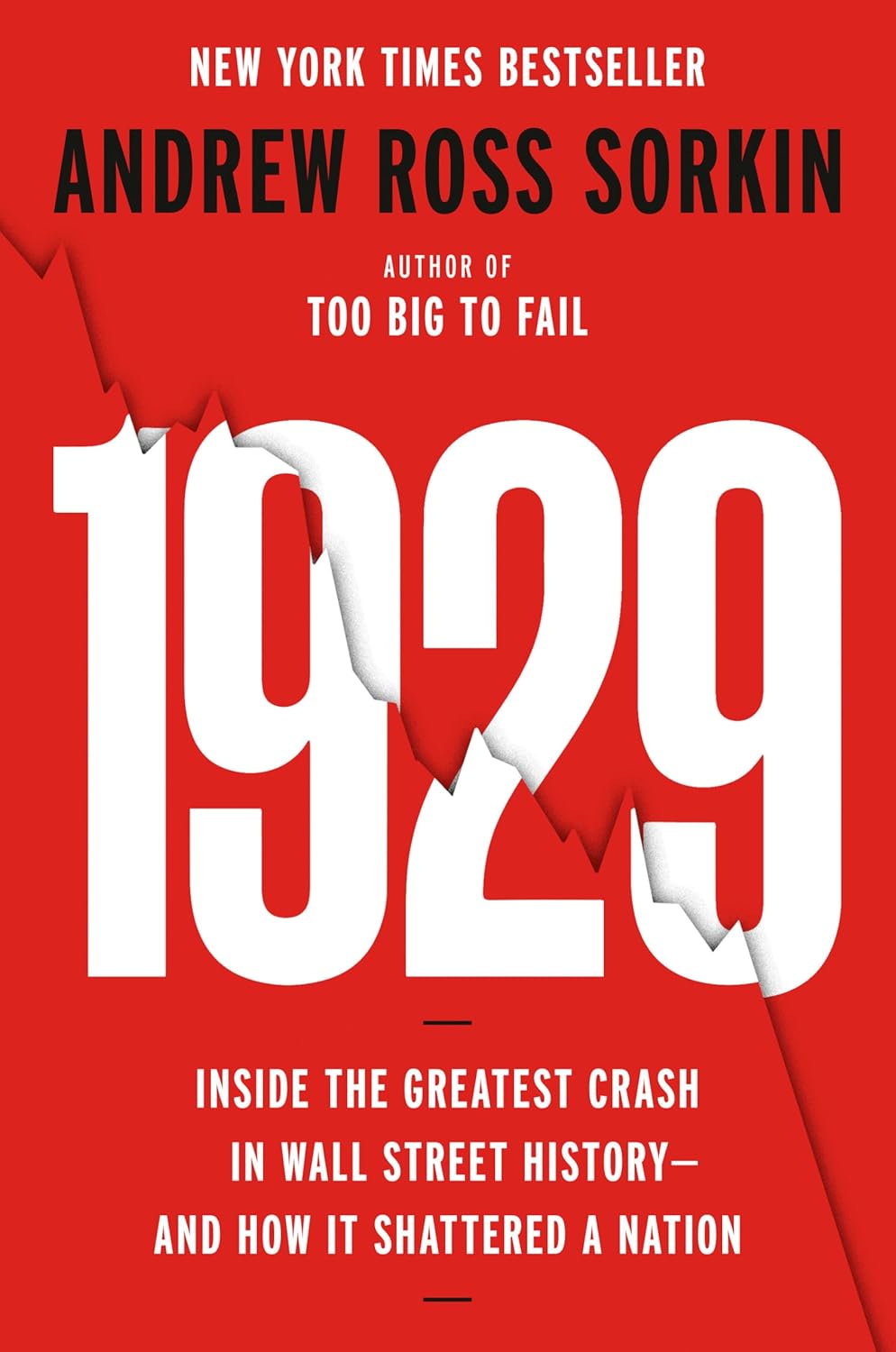
1929

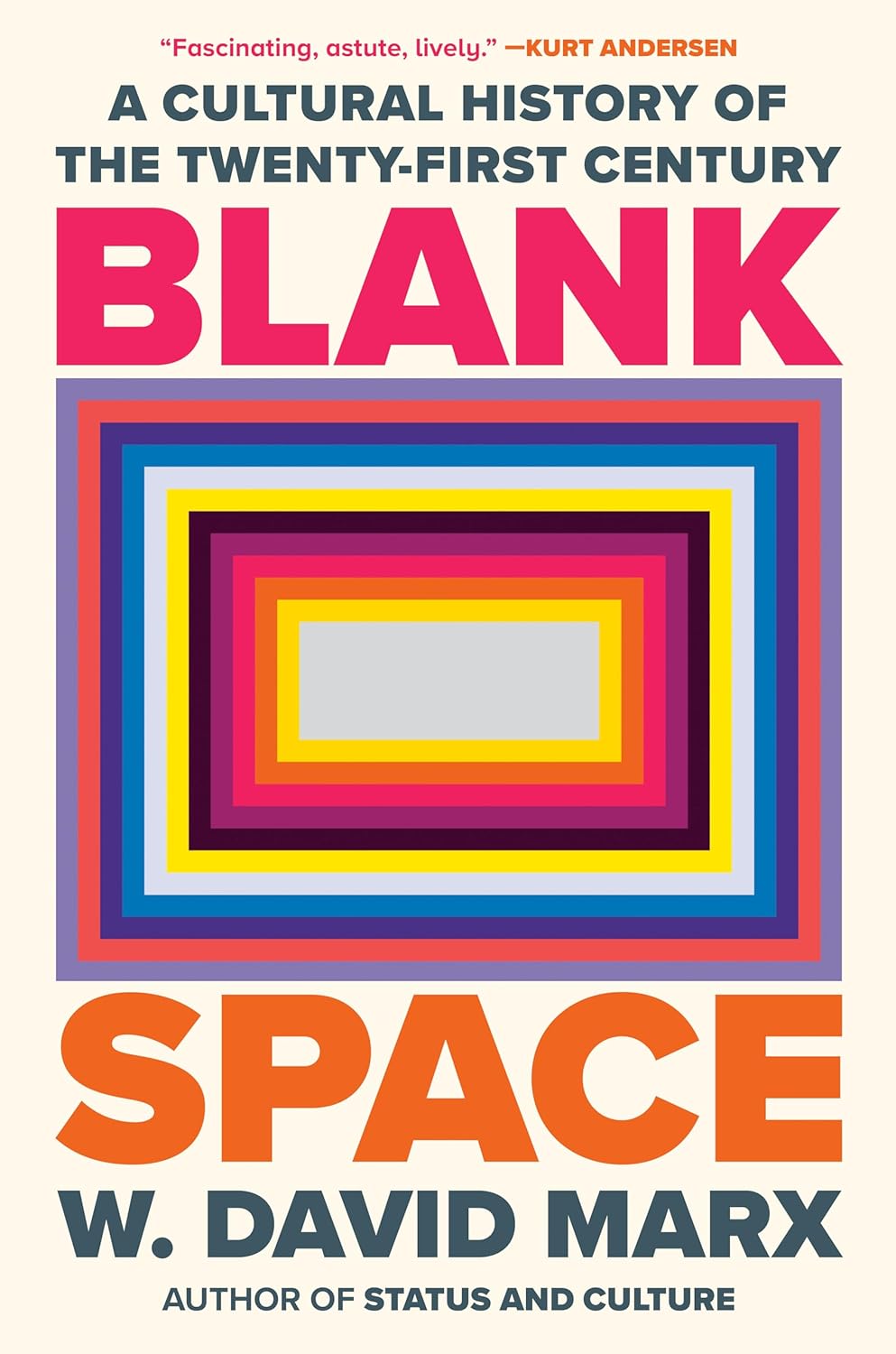
Inside the Greatest Crash in Wall Street History--and How It Shattered a Nation

(paid link)

I put this book on my get-at-library list thanks to a decent review at the WSJ. The reviewer, Judge Glock, deemed it "one of the best narrative histories I’ve read."

The author, Andrew Ross Sorkin, clearly performed a huge amount of research, much of it from primary sources. He concentrates on the people involved: folks who did stuff, and folks to whom it was done to. In the early going, he draws the well-known picture of ordinary Joes, and some Janes, getting swept up in a stock-buying mania. Not investing, but speculating. Making big bets that the market would keep going up, up up! Which worked out well, until it didn't.

Sorkin looks at dozens of characters (there's a dramatis personae list at the book's beginning), but there's a relative concentration on just a few. One major character is Charles Mitchell, who headed up New York's National City Bank (today's Citibank). He was also on the Board of Directors of the New York branch of the Federal Reserve. (I'm not sure whether such dual employment is legal any more.) He is the closest thing the book has to a villain, or maybe a scapegoat. Certainly he gathered some powerful enemies, most notably Senator Carter Glass. (Co-author of the Glass-Steagall banking law.) Eventually, some of Mitchell's sketchy deals wound him up court on a tax evasion rap; he was acquitted to the dismay of many.

So it's quite a ride. Despite the book's title, only the first part describes the events of 1929; the remainder covers efforts going up to 1933. (And then both an "Epilogue" and an "Afterword" describes what happened to everyone after that.)

Sorkin relies probably too heavily on John Kenneth Galbraith's The Great Crash for causal analysis of the Depression. In comparison, the Milton Friedman/Anna Schwartz book A Monetary History of the United States gets a brief nod on page 440 as "authors and academics" with an alternative explanation. Three pages from the end of the book's text! Sorkin also mentions, but doesn't really explain, why the recovery in the U.S. was relatively slow compared to other countries.

So, it's pretty good, but if you're interested, I'd recommend wider reading.

Conscious? Thank Your Posner Molecules!

Sabine Hossenfelder highlights recent speculation: Consciousness Comes From Quantum Processes, Physicist Claims.

It's a point I've made before, but will nevertheless repeat: this doesn't say anything about "free will". Some misguided souls (for example, me, back when I was a college student) think that quantum behavior can give rise to "free will"; it doesn't. It just adds some (unproven) speculation about quantum-level unpredictable coin-flipping in your brain. But this doesn't put "you" in charge of your actions, determinists (correctly) point out.

And, for the record, Sabine classifies this particular speculation as "bullshit" in any case. Still, it's fun to hear her explain it with a German accent.

Also of note:

  • Just around $3 million per job. Joe Lancaster notes a very expensive stretch of the Road to Serfdom: Michigan spent $1.8 billion and only created 602 jobs.

    One of the great economic myths that never seems to die is the idea that giving taxpayer money to a private company will yield a windfall, incentivizing the company to create jobs and generate wealth that otherwise would not exist.

    And yet time and time again, the benefits fall far short of what was promised, if they materialize at all. A new report suggests the state of Michigan is the latest to learn that lesson the hard way.

    "Michigan Gov. Gretchen Whitmer offered billions of taxpayer dollars to select companies in an effort to create jobs during her eight-year term," writes James M. Hohman, director of fiscal policy at the Mackinac Center for Public Policy. "Overall, she has authorized $6.9 billion for business subsidies since gaining office in 2019."

    In a new report, Hohman examined eight major projects—"those that offered $100 million in payments and received significant media attention"—totaling $2.7 billion in promised incentives. Hohman then assessed how the investments paid off.

    Governments have a terrible track record of picking winners and losers, and it turns out that Michigan, under Whitmer, did not break the trend.

    When it comes to government spending, overpromising and underdelivering is the way to bet.

Recently on the book blog:

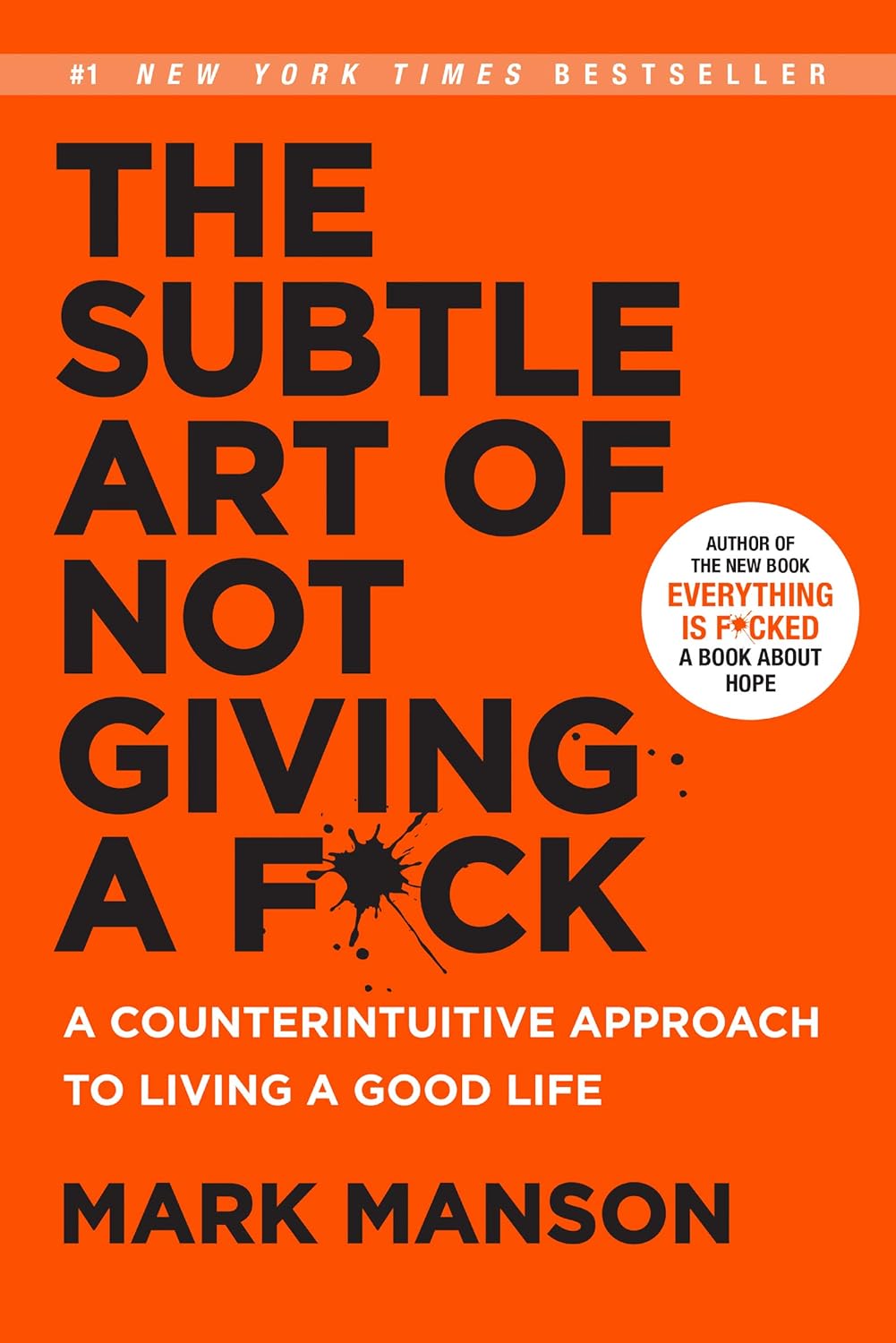
The Subtle Art of Not Giving a F*ck

A Counterintuitive Approach to Living a Good Life

(paid link)

A couple months back I was sufficiently impressed with Mark Manson's rant about intellectuals to add his substack to my reading list and (eventually) to check out his 2016 book on the topic of …

Well, you can read the title as well as I can. Reader, the blotted-out word on the jacket is not asterisked or otherwise obscured anywhere else in the book. And Mark uses it a lot, usually gratuitously. In his defense, that's become kind of common these days, and the word has lost a lot of its power to shock.

Worse, the title does not accurately reflect Mark's main thesis. When he urges the reader to not give a you-know-what about something, he's asking you to not care strongly about that thing. There are broad classes of things like that: basically, things that are outside your control.

But he further observes that there are things you should care strongly about. Specifically, living in tune with your carefully selected values, like honesty, temperance, courage, justice, etc.

So a better title for the book would have been The Subtle Art of Knowing What to Care About, and What Not to Care About.

It didn't take me long to say: Hey, this sounds a lot like stoicism. I don't think Mark says that directly, though. To be fair, I might have missed it. Mark's prose style does not encourage careful reading; it comes across, at times, as a transcription of a slightly-drunken rant.

So an even better title for the book might have been Stoicism, Loosely Described With Dirty Words.

For what it's worth, one of the back-cover blurbs is from Ryan Holiday, who is an explicit Stoic advocate. I read his book Stillness Is the Key a few years back, and thought it was decent. If you're looking for self-help with a Stoic twist, I'd recommend Ryan over Mark.


Last Modified 2026-07-03 6:43 AM EDT

Clown to the Left of Me, Joker to the Right

Pun Salad has previously mentioned probable future CongressCritter Darializa Avila Chevalier twice in the past two days. It's not as if I'm obsessed or anything!

But yes, I'm going for the hat trick. Noah Smith is a self-confessed Democrat, who is unhappy because The Democrats have their own MAGA now. After noting some of her more deranged stances:

If this all sounds absolutely crazy, it’s because it is. The woman who said all of these things is going to be a U.S. Representative — not a state representative, or a member of a city council, but a member of the United States’ highest legislative body. And she will be a Democrat — she will be formally supported by the Democratic Party, she will presumably caucus with the Democrats in Congress, and so on.

Avila Chevalier is as much of an extremist as anyone associated with the MAGA movement. The best comparator on the right would probably be Marjorie Taylor Greene, who has made a long string of similarly extreme and wacky statements. My typical line is that “both extremes are bad, but the Republican extreme is worse”. Avila Chevalier is severely testing that asymmetry.

Nor is this a case of one wacky person winning a lone, lucky victory. Avila Chevalier was one of three Congressional primary candidates backed by New York City’s powerful and charismatic mayor, Zohran Mamdani. All three won their primaries this week, and two of them — including Avila Chevalier — unseated incumbent Democrats.

So we'll see how that works out for them. Meanwhile, here in the Granite State, we have our own candidate, as reported by NHJournal: From Mamdani to Manchester? Howard Bets on DSA Momentum in NH-01.

Now that Democratic Socialist candidates are winning primaries with the message of “Abolish ICE, Defund the Police, and Free Palestine,” will New Hampshire’s only DSA-backed candidate stay that course as well?

So far, it appears so.

State Rep. Heath Howard (D-Strafford) has been endorsed by the Southern NH DSA.

“SNHDSA is proud to endorse Heath Howard for Congress. Heath is running for NH-01 to build power for working people across the Granite State,” the organization said in a statement.

“He will fight for universal health care, the repeal of Taft-Hartley to strengthen unions, a livable wage, and the affordable housing our neighbors deserve.”

And, the group added, Howard is “the only anti-Zionist candidate in the race, and has pledged to take zero dollars from AIPAC.”

Anti-Israel and, some say, antisemitic rhetoric was a key part of the messaging from the DSA-backed candidates who won in New York Tuesday. And they all had the help of aggressively anti-Zionist Mayor Zohran Mamdani.

Heath Howard's campaign site is here. His issues page is a "progressive" wishlist. Example under the "PROTECT OUR DEMOCRACY" item:

Our democracy has been crumbling for decades. Citizens United didn't just open the floodgates to corporate cash in politics, it also drowned out the voices of everyday Americans. Today, our nation isn't governed by 'we the people,' but by the billionaire class. We must overturn this disastrous ruling with a Constitutional amendment to reclaim our elections from billionaires and special interests because democracy shouldn't be for sale. Moreover, we must remove the limit on the number of Representatives in the U.S. House to ensure a much larger, truly representative body for the third most populous nation on Earth, implement ranked-choice voting, prosecute illegal foreign influence groups such as AIPAC, ban members of Congress from becoming lobbyists upon leaving office, and abolish the electoral college.

Sorry, Heath. You're demanding, essentially, a partial repeal of the First Amendment. Sounds like a bad idea.

Also, calling AIPAC an "illegal foreign influence" group is, well, unhinged.

Also of note:

  • Another bad idea Heath Howard is for. Veronique de Rugy points out a small problem: Eliminating the Payroll Tax Cap Undermines Social Security's Earned-Benefit Principle.

    Bernie Moreno and Elizabeth Warren have a New York Times op-ed proposing to eliminate the cap on Social Security payroll taxes, not the benefit it funds. Jack Salmon has made the case for why this proposal is not the solution they make it sounds to be: even full cap elimination with no added benefit credit closes only about 58 percent of the 75-year shortfall today. Over at National Review, Ramesh Ponnuru also explains that if we stack a 12.4% uncapped payroll tax on top of the 37% top income tax bracket, it will push the marginal rate on a top earner’s wages to 49.4% — the fastest run-up in the top rate since the 1930s, on a tax design that’s already more aggressive toward high earners than most of the advanced-country pension systems we’d be comparing ourselves to.

    There is another big problem for Warren and Moreno. A few sentences after proposing to uncap the tax, Moreno and Warren say it’s essential to “safeguard Social Security’s earned-benefit structure.” The earned benefit part is an argument we always hear when anyone ever evokes making reforms to the insolvent program. It goes something like this: “Oh but I have paid into the system, and I have earned my benefits so you can’t touch them.” And in fact, Warren and Moreno use that rhetorical tool to at the beginning of their piece:

    “Social Security is a core component of our nation’s promise — a covenant between the federal government and Americans who pay into it throughout their working years so they can retire with dignity.”

    But here is the thing. They obviously don’t realize that earned benefit argument is precisely why the cap exists in the first place. As Ponnuru explain in the Washington the cap is here to keep benefits related to contributions. In other words, lifting the cap would partially sever the earned benefit intent of Social Security and turn it more into a general welfare program rather than an earned benefit. Indeed, their plan, by design, doesn’t credit the newly taxed earnings with any new benefit, which is precisely how it raises money. This fence that Democrats have erected for forty years around any conversation about the spending side of Social Security, such as raising the retirement age, means-testing benefits for high earners, slowing the COLA formula, adjusting the bend points, would go away if your lift the cap.

    Yeah, it's bogus. But asking progressives to abide by "principles" is a non-starter when there's plundering to be done!

  • Do you know the way to way to the Fay in San Jose? Randal O'Toole looks at the latest disaster site: Planning Fantasies Crash and Burn.

    “Parking minimums are a waste of money and land,” planners argue, so they immediately turn around and impose parking maxima, saying that people will be happy to live without cars if they aren’t required to pay for parking. Many developers have learned to their sorrow that this isn’t true, the latest being Scape, a British developer that was persuaded to build a 23-story apartment tower on the edge of downtown San Jose. Calls the Fay, the building offers only one parking space for every three units and the developer was unable to fill units that didn’t come with parking spaces.

    As a result, the developer defaulted on its $182 million construction loan and the lender foreclosed on the property just ten months after it opened. The city of San Jose took the building off the lender’s hands with the promise that it would provide “affordable housing” to city employees. The city said it would allow those employees to park their cars at city hall, thus undermining the whole “live without a car” philosophy. But since that was seven blocks away, few employees have taken advantage of it, and the building remains 60 percent vacant.

    Well, they took their chances. Sorry it didn't work out.

  • "If we take the widest and wisest view of a Cause, there is no such thing as a Lost Cause because there is no such thing as a Gained Cause." T.S. Eliot said that, and I'd like to believe him. Because, at Reason, Steven Greenhut notes that one of my causes isn't doing so well: From Buckley to Trump, conservatism has endured an ugly slide.

    Politically active people my age fondly remember conservative intellectual William F. Buckley hosting the wildly popular TV show, "Firing Line," where he for years interviewed luminaries from across the political spectrum. He sparred with leftist Noam Chomsky about American imperialism, chatted with British Prime Minister Margaret Thatcher about the future of free markets, and talked to poet Allen Ginsberg about drugs and spirituality. Heady stuff.

    These lofty civil debates went beyond politics and delved into psychology, art and literature. The show reflected an emerging conservative movement that was clever and optimistic, and which preferred to out-argue opponents rather than "own" them. That era's leading right-leaning commentators often criticized intellectuals, but not intelligence and expertise.

    Which brings us to our current moment. We have an undreamed-of abundance of information—podcasts, social media, cable TV, talk radio, streaming and endless publications of every type. We can hear first-person utterances from our country's leaders. We have extensive access to governmental budgets, legal decisions, public meetings, federal rule-makings and legislation. We have everything we need to be the informed citizens our founders envisioned.

    Yet these are the stupidest times. They also are illogical, bigoted, conspiratorial and tribal times. I enjoy reading posts from one thoughtful anti-MAGA conservative and a large percentage of rebuttal comments are of this variety: "You're a Jew." There's no appetite for intellectual honesty or treating opponents with decency. It emanates from the highest levels, as the president unleashes daily tirades that show the reasoning skills of a buffoon. Official federal government accounts dish out invective adorned with cartoonish AI graphics that appeal to vulgar 14-year-olds.

    I'm not sure whether Steven's nostalgia is too rosy, or his view of our current state too dim, but (as always) see what you think.

  • Don't give Wikipedia a dime. I notice that Wikipedia is doing one of its periodic begathons. Let Larry Sanger tell you about it: I Co-Founded Wikipedia. Now I’m Banned for Life.

    Twenty-five years ago, I co-founded Wikipedia, arguably the most important encyclopedia in human history. On Monday, I was indefinitely banned from the site. The story of what happened to me is, in many ways, the story of our censorious times, in which independent thinking is seen as a threat rather than a virtue, and punished as such.

    It's a long story, one well worth your reading time.

Worth a Thousand Words, Maybe More

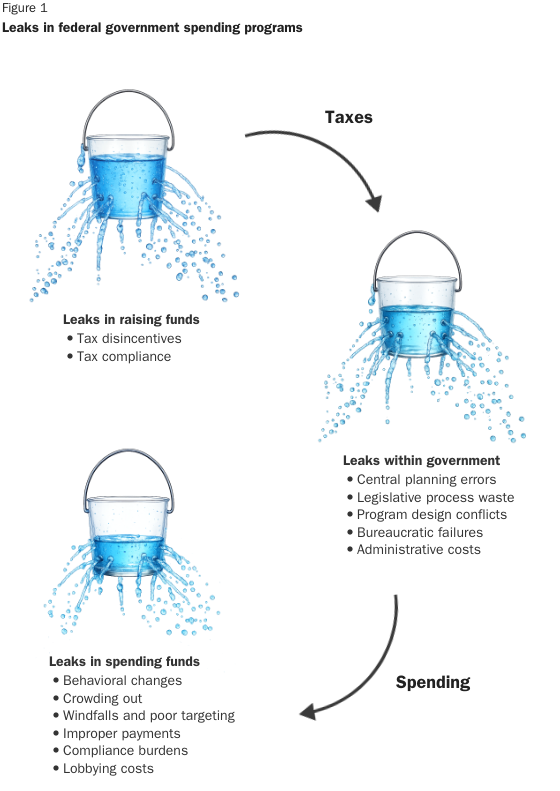
Via Daniel J. Mitchell, an easy-to-understand visualization of government sending programs:

That's from a Cato Policy Analysis from Chris Edwards and Ryan Bourne titled, aptly enough, Federal Government Spending Is a Leaky Bucket. From the introduction:

People often hold optimistic views about federal government spending programs. They assume that new and expanded programs can fix the nation’s social and economic problems. The government is a powerful institution, and so people think that it can steer funding to individuals, businesses, and nonprofit groups to solve problems and aid those in need.

However, solving problems through the federal government is not so simple. Spending programs require funding from taxation or borrowing, and both create collateral damage on the economy. As funds flow through the government, resources are wasted on bureaucracy, mismanagement, and faulty planning. As the remaining funds flow out of the government and into the private sector, they induce people to change their working and investing activities, further undermining the economy. Only a fraction of the tax dollars raised for programs ultimately delivers on the outcomes promised by policymakers.

So check it out, if your blood pressure is safely under control.

In the past, I've called this the "D.C. Shuffle". It's a dance move often accompanied by the spenders claiming they have done you a great favor, taxpayer.

And I've noticed that the biggest advocates of government spending often deride free-market economics as "trickle-down". Look at that diagram; doesn't this deserve the "trickle-down" epithet?

Also of note:

  • Whom the gods would disappoint they first make greedy. Veronique de Rugy nots a truism: From London's Tennis Courts to California, Aggressive Taxes Always Disappoint. If you don't follow professional tennis, this might be news to you (as it was to me):

    Last week, nearly every elite men's tennis player skipped one of London's marquee tournaments. Only one of the world's top 10 showed up at Queen's Club, the traditional Wimbledon warmup; stars including Alexander Zverev, Daniil Medvedev, Taylor Fritz and Ben Shelton were playing 300 miles away in Halle, Germany. A culprit was likely Britain's tax code, which doesn't stop at taxing prize money earned on British soil.

    It also taxes a slice of a player's global endorsement income, prorated by how many days of the year they happen to spend in the UK. Fail to advance far enough in the tournament, and the tax bill on your sponsorship deals can exceed your payout. So, the players who get to choose where they compete are now choosing somewhere else.

    "(I)t's not about the money for playing," retired superstar Rafael Nadal once explained. "They take from the sponsors. ... This is very difficult. I am playing in the UK and losing money."

    File this story under "how people dodge taxes by leaving." Evidence for the phenomenon was piling up long before California billionaires began their high-profile relocations to Nevada and Florida ahead of a proposed wealth tax on the ballot this November. And it's not the only reason these taxes disappoint.

    So Atlas is not only shrugging, he's not playing pro tennis either. Vero notes the wannabe plunderers are trying to come up with schemes that make mobility and refusal more difficult.

  • If you want me, I'll be over in Tomorrowland. Peter Suderman provides his observations of The DSA and the Democrats' retreat into economic fantasyland. Focusing on a probable CongressCritter come January 2027:

    Of the trio of candidates who swept to victory in New York this week with the backing of Mayor Zohran Mamdani—all of whom are or have been associated with the Democratic Socialists of America (DSA)—none has generated more attention than Darializa Avila Chevalier.

    Chevalier, who has never held office before, is a 32-year-old community organizer who this week won a Democratic primary in New York against incumbent Adriano Espaillat. Like many DSA-affiliated up-and-comers, Chevalier has a long history of incendiary social media posts. As Reason's Liz Wolfe noted yesterday, she's called former President Joe Biden a "rapist" and a "war criminal." She once posted "fuck Kamala Harris." Remember, she just won a Democratic primary.

    She also described the United States as a "fucking disgrace," though it's apparently not quite so disgraceful that she doesn't want to take the title and salary of U.S. congressional representative. As center-left writer Jeff Maurer wrote, it will be extraordinarily easy for Republicans to portray her as a radical, anti-America lunatic "because she is a radical, anti-America lunatic."

    But Chevalier is not just an unusually unhinged, radically anti-American social media leftist; she's also a committed economic socialist who supports creating a four-day, 32-hour work week with no pay reduction, free government-sponsored childcare, free pre-kindergarten, Medicare for All, and a federal rent control system, presumably because rent regulations have worked so well in New York. Somewhat confusingly, she also supports both a universal basic income and a federal jobs guarantee, which raises the question: Why would you need a federally guaranteed job if you have a federally guaranteed income?

    In any case, after reading several academic studies, conversing with some economists and pollsters, and trying to assess her policy agenda neutrally, I have concluded that she is, in technical terms, cuckoo bananas.

    Cuckoo bananas? Since when has that been a disqualifier for political office?

  • I envision a remake of "The Odd Couple". The WSJ editorialists celebrate A Roundup Supreme Court Victory. (WSJ gifted link)

    Mass torts spread like weeds and may be even harder to stop. The good news is that a 7-2 Supreme Court majority on Thursday eradicated one major scourge by ruling that federal law pre-empts most state claims involving the pesticide Roundup (Monsanto v. Durnell).

    Plaintiff attorneys have filed thousands of lawsuits in state courts against Bayer, which owns Monsanto, claiming that Roundup’s main ingredient glyphosate gave them cancer. They also say Bayer should have warned about the alleged risk. But as Justice Brett Kavanaugh explains in the majority opinion, such claims are expressly pre-empted by the Federal Insecticide, Fungicide, and Rodenticide Act (Fifra).

    Shorn of all the legal analysis, the WSJ notes the bullet this decision dodges: "The real plaintiff goal is to loot Bayer, no matter the plain letter of the law."

    But what I really wanted to point out: the dissenters were Ketanji Brown Jackson (I expected that) and … wait a minute … Neil Gorsuch?!

    That's an odd couple, indeed.

  • Almost needless to say, but I'm saying it anyway. Jim Geraghty is being sarcastic. Say, I'm Starting to Think These Iranian Mullahs Might Not Be Trustworthy.

    In perhaps the least surprising news ever, Iran is breaking the promises it made in the memorandum of understanding.

    Iran’s Islamic Revolutionary Guard Corps attacked a Singapore-flagged cargo ship Thursday in the Strait of Hormuz, according to two senior U.S. officials, testing the deal signed last week by the U.S. and Iran to end the fighting and reopen the vital shipping lane.

    The attack, which damaged the ship’s bridge but left no casualties, according to U.K. Maritime Trade Operations, took place near the coast of Oman hours after the Iranian paramilitary’s navy warned ships not to use routes through the waterway that the regime hadn’t sanctioned.

    When you write that the memorandum of understanding is a terrible deal, you get told by fans of this administration that you’re rushing to judgment, that it is far too early to come to that conclusion, and, just wait, the president and vice president know what they are doing and everything will work out just fine.

    No, the deal is not getting better with time.

    And don't hold your breath waiting for that four-dimensional chess stuff to manifest itself.


Last Modified 2026-06-27 6:56 AM EDT

When They Tell You Who They Are, Believe Them

For example, Mr. Ramirez appears to believe them:

A couple text pieces to go with the Eye Candy du Jour: First up is Noah Rothman's indictment: The DSA Is a Hate Group, and What It Hates Is America. (archive.today link)

The DSA cannot be coopted, mollified, and incorporated into a broader political coalition. It is not a constituency. It is a hate group. And the object of its hatred isn’t the “Zionists” as they increasingly euphemistically refer to Jews, or the capitalist enterprise. It is America itself. For a while, though, casual observers could be forgiven for thinking that this rabid sect just had a pathological contempt for Israel.

Even as Hamas terrorists were still at large inside Israel — raping, torturing, and massacring any Jew in their line of sight — the DSA held an “anti-Israel” rally in “solidarity” with the terrorists, who were “not unprovoked.”

They kept up the pace in the weeks that followed. Almost 140 people were arrested during a nighttime march through New York City — a menacing, destructive outburst in which marchers held signs that read, “I do not condemn Hamas,” and chanted, “There is only one solution. Intifada. Revolution.” On October 28, 2023, thousands attended a DSA rally, which they called “Flood Brooklyn for Gaza” in a direct reference to the October 7 operation that Hamas called “al-Aqsa Flood,” throttling traffic on roads and bridges and harassing Jews.

Antisocial? Yes. Bigoted? Sure. Criminally malicious? Definitely. But anti-American? Democrats could still tell themselves that was a bridge too far.

But as Noah goes on to document, that ain't so.

At the WSJ's "Free Expression" newsletter, James B. Meigs checks out The Radicals Inside the Tent. (WSJ gifted link)

“Free, free Palestine!” the crowd chanted when New York Mayor Zohran Mamdani arrived at the Tuesday night party celebrating the primary win of his close ally, Claire Valdez. Given the city’s paucity of Republican voters, Ms. Valdez is almost certain to win a seat in the U.S. House of Representatives come November. So are Brad Lander and Darializa Avila Chevalier, two other insurgent candidates backed by the mayor.

Like Mr. Mamdani, all three upstart candidates have roots in the far-left Democratic Socialists of America. Their primary victories help cement Mr. Mamdani’s “status as a formidable kingmaker,” the Journal reports. Once they arrive in Washington, the new members of Congress will share an agenda much broader than protecting the parochial interests of New Yorkers. Ms. Valdez and Ms. Chevalier consider themselves part of a socialist vanguard. Their campaigns focused on claims that Israel is committing a “genocide” in Gaza. As the “Free Palestine” chants suggest, their closest supporters also believe this election reflects a global radical movement.

And (also at the WSJ), James Freeman warns: Here Come the Mamdani Marxists!. (WSJ gifted link) Concentrating on the DSA's victorious primary candidate (and likely future CongressCritter) Darializa Avila Chevalier:

Ms. Avila Chevalier’s history of commentary certainly ought to embarrass her. Andrew Kaczynski and Em Steck reported recently for CNN on a series of online comments that have since been deleted:

During the early months of the Covid-19 pandemic, Avila Chevalier reposted a message calling for a sweeping government takeover of large parts of the economy. The repost advocated nationalizing utilities, hospitals and pharmaceutical companies; suspending rent and mortgage payments; dissolving private health insurance companies; and “seiz[ing] all properties from landlords.”
Other deleted posts and reposts included references to communism and anti-capitalist politics. In one April 2020 post, Avila Chevalier wrote that while most of the political theory she had read was communist, “the pyromania associated with anarchism is very intriguing to me,” adding a laughing emoji.
“Seize the means of production,” she wrote in a since-deleted 2019 post, the phrase commonly associated with Marxism.

Yes, that is exactly the line used by the world’s most murderous dictators. And there’s more […]

There's more, but that's enough for me. Unfortunately, probably unproblematic to the voters in Ms. Chevalier's district.

Also of note:

  • A perennial question. And Elizabeth Nolan Brown asks it: Who Owns Your Data?

    Can police get your digital information and make you a suspect just because you happened to be in a location at a given time or happened to search for certain terms online? The U.S. The Supreme Court is expected to weigh in next week.

    The court must decide whether cops can use what are known as "geofence warrants"—requests for information on every phone that was in the vicinity of a crime scene or every person who used a search engine to look up a certain topic on a certain date. Geofence warrants let law enforcement go on fishing expeditions, obtaining data on numerous people without presenting probable cause against any one of them specifically or naming a specific person or device to be searched.

    Note the question-begging inherent in the "Who owns your data?" question. Try asking again without the thumb-on-the-scale word "your".

    Data doesn't exist in a vacuum, though. (Well, unless it's encoded in some electromagnetic wiggles… come on, you know what I mean!)

    So my half-serious answer to data ownership: it belongs to whoever owns the media it's maintained on.

  • Warning: Don Draper photo at link. But Jeff Maurer uses it to bolster his perhaps-true claim: Capitalism Has a Brand Problem.

    Much of Jeff's article is a response to a BBC video segment featuring "deep-fried, smothered-and-covered moron: Italian economist Clara Mattei" engaging in "ahistorical lunacy." Self-recommending, but I can't figure out how to embed the clip. So let's skip down a bit for our excerpt. What's wrong with "capitalism?"

    I think it’s largely because the word “capitalism” invokes a bunch of stuff that isn’t really capitalism. The technical definition of capitalism is simple: It means buying and selling stuff with prices determined by the market. A grandmother selling homemade pies at a roadside stand is a capitalist, and so are all the small businesses that Americans love to fetishize. But when many people hear “capitalism”, they think “Wall Street stuff” — they think of slick-haired guys in suspenders, $500 cigars, The Wolf of Wall Street, political cartoons of fat cats scratching each others’ backs, and annoying corporate stuff like Ticketmaster having the balls to call a $14 surcharge a “convenience fee”. But those things aren’t capitalism; they’re some of the most annoying features of capitalism. Anything defined by its worst features will be unpopular; nobody would like puppies if the word “puppy” made you think “a thing that shits, sheds, and watches you masturbate.”

    Jeff suggests advocates use instead:

    “Free enterprise” is a good term for capitalism because capitalism isn’t really a system: It’s the absence of a system. The main way that Clara Mattei is wrong — and there are galaxies of ways that she’s wrong, but this is how she’s most wrong — is that capitalism wasn’t created by anyone. If you leave people to their own devices, they make stuff, they buy stuff, and market forces are the natural product of that interaction. Economic systems like feudalism and communism are an attempt to control economic relations; capitalism is what happens when you let those relations be free.

    I will point out (and commented on Jeff's article): Reason magazine has had the masthead motto "Free Minds and Free Markets" since (I think) its inception. It hasn't taken the world by storm.


Last Modified 2026-06-25 11:22 AM EDT

Trivia: His Real Name is Jimmy McGill

But Saul Goodman has more video thoughts for you:

I'm not as reverent to the sacred cow of "Democracy!" as is Saul (or Mike). A sampling of Pun Salad posts on the topic: here, here, here, assorted items here, here, here, and here.

Also of note:

  • Among the multitude of insults to voters… Jack Butler has a peeve with the language employed by Working-Class Zeroes, all of whom strive for "authenticity." (WSJ gifted link)

    The best way for politicians to appeal to voters now, especially those considered “normal” or “working-class,” is apparently to assume the worst of them.

    Consider Dan Moraff, one of the political operatives who recruited Graham Platner to run in Maine’s Democratic Senate primary. Mr. Moraff paid a firm to probe Mr. Platner’s past for anything potentially problematic. The search yielded some of the outré posts Mr. Platner had made on Reddit. He wondered why black people supposedly don’t tip, identified as a communist and suggested that “there are times in this world when, for the good of tolerance and humanity, you need to kill a m——.”

    Mr. Moraff claims that he views Mr. Platner’s uncouth ruminations not as an obstacle but an asset. Voters, he believes, “want people who are real human beings, and they want people who do not look and sound like the vat-grown people who’ve been leading this country off the cliff for the past century, and that’s Graham.” In a statement provided to the Journal after revelations of Mr. Platner’s shady romantic past, Mr. Moraff said that he’d let “the people of Maine decide” whether he’d vetted his candidate sufficiently.

    News flash: A candidate who thinks you'll be impressed by his potty-mouthed vocabulary does not have a high opinion of your intelligence.

  • Speaking of psyops preying on the weak-minded. Jim Geraghty notes what Team Orange is up to: Trump’s Face Takes over Washington.

    On the way to the Washington studio of CNN yesterday morning, I passed by the U.S. Department of Labor building at 200 Constitution Avenue, which currently has a pair of giant banners adorning it — one of former President Teddy Roosevelt, who former Labor Secretary Lori Chavez-DeRemer inducted into the Department of Labor’s Hall of Honor back in September.

    […]

    The other massive banner on the Department of Labor building is of our current president, Donald Trump. Last year, a department spokesman said the banner cost taxpayers about $6,000. (If you find that kind of frivolous expense sobering, that may be the only part of Chavez-DeRemer’s time as secretary that was.) At an August cabinet meeting, Chavez-DeRemer said, “Mr. President, I invite you to see your big, beautiful face on a banner in front of the Department of Labor, because you are really the transformational president of the American worker.”

    To clarify, the giant Trump banner on the Labor Department building is different from the large banner of Trump’s face on the U.S. Department of Justice building at 950 Pennsylvania Avenue. No estimate for the cost of creating and installing that banner has been released.

    This is separate from the large banner with Trump’s face that was put up on the U.S. Department of Agriculture building in May 2025 and taken down by August. According to FOIA requests filed by Bloomberg News, the banners and the supplies used to hang them cost taxpayers a total of $16,400.

    Reader, it goes on from there, because other examples abound. What combination of narcissism (on Trump's part) and insincere pandering to that narcissism (on his minions' part) is left for the reader to guess.

  • The day was young… when James Freeman posted his article: The Latest Whoppers From Bernie Sanders (WSJ gifted link). So they may not be actually the latest as you read this. Still:

    Like the communist thugs he has long supported, Sen. Bernie Sanders (Socialist, Vt.) is a relentless teller of falsehoods. The latest appalling example is his declaration that artificial intelligence software developed by tech companies is “a public resource,” even though it is created by private organizations and does not belong to the government. This Sanders falsehood is used to justify his draft plan for the government to seize half the shares of what he deems “systemically important” AI companies.

    One naturally wonders—if he actually believes his false claim—why he’s not demanding that government seize all of the shares. Even Sen. Sanders probably understands that AI companies would be worthless without the hardworking, creative people inside them and that a total seizure would cause everyone to flee.

    I note the cartoon I posted five years ago::

    [Other People's Money]

    At the time I observed: "Linus Grew Up to be Bernie Sanders."

  • Sure, it never hurts to ask honest questions. A thought-provoking article at the Dispatch from Joseph O. Chapa: AI Is Making Us Question What It Means to Be Human. Should It? (Dispatch gifted link)

    The AI debates in recent years have been dominated by loud voices on two ends of a wide spectrum. The so-called “doomers” emphasize the risks—the possibly existential risks—advanced AI may pose to humanity. At its most extreme, doomers believe that AI will become so powerful that it will pose an existential threat to the human race. Meanwhile, the “boomers” paint a picture of the utopia  that advanced AI may be able to bring about. Jobs? No one will need jobs once we’ve got universal basic income thanks to the prosperity AI generates. Indeed, venture capitalist Marc Andreessen’s Techno-Optimist Manifesto declares that “there is no material problem–whether created by nature or by technology–that cannot be solved with more technology.”

    Both the “boomer” and the “doomer” views make sense only if we suppose that AI will continue to develop in leaps and bounds just as it has done since OpenAI released GPT-2 in 2019. But even if AI capability were to plateau at its current levels, chatbots that use our languages, models that can create visual art, and AI-enabled tools that can help strategize for war raise fundamental questions about what sets humans apart from sophisticated machines. Now that AI has so many capabilities that we have always considered strictly human, we have to ask, what can the rapid development of modern AI teach us about ourselves?

    Chapa's article is a good overview of AI's history (going back further than you might think) and the current swirling issues. I'm not entirely satisfied with his conclusions, but see what you think.

Recently on the book blog:

How to Survive in the Woods

(paid link)

I've become sort of a Kat Rosenfield fanboy. Although I didn't care for the book she co-authored with the late Stan Lee (A Trick of Light), I liked her next two adult novels, (You Must Remember This and No One Will Miss Her) quite a bit. And this one goes beyond "liked quite a bit" on my scale. I found myself torn between compulsive page-turning (gotta find out what happens next) and slow reading, savoring her prose.

Well, enough gushing. I encourage you to not read the blurbs on the book's Amazon page, nor the dust cover. Part of the enjoyment for me was the I-didn't-see-that-coming plot twists, and they are numerous.

I'll just skim over the prologue, going up to page 9 or so: the protagonist, Emma Sharp, is getting released from the hospital after a nearly-successful suicide attempt. Of all the unlikely coincidences, the Uber driver who's supposed to take her home is Logan, kind of snoopy and forward. Their relationship starts out dysfunctional. And gets worse.

The "woods" in the title are in Maine. Most of the action happens on and around the "Hundred Mile Wilderness" section of the Appalachian Trail, on the route to Mount Katahdin. It's risky enough all by itself (article: 5 Dangers that Could Kill You Hiking the 100 Mile Wilderness), and, well, those dangers aren't the only ones with which Emma needs to concern herself.

Vandalizing Our Way to Prosperity!

An excerpt from Monday's WSJ "Free Expression" newsletter by Matthew Hennessey: (WSJ gifted link)

Seen vs. Unseen: Students of economics immediately recognized Frédéric Bastiat’s “parable of the broken windows” in a story out of Oakland, Calif. “A decline in car break-ins across Oakland is being welcomed as a public safety win, but it is also contributing to a downturn for some local auto glass repair businesses,” reports KTVU Fox 2. Writing in 1850, Bastiat helped us understand that not all economic activity is a net positive for society. Vandalism generates business for the window-repair man, and his profitable employment shows up in statistics. But without an appreciation for opportunity costs and unintended consequences, a true accounting is impossible. A society that focuses only on what it can see, and ignores the unseen, easily arrives at the false conclusion that vandalism is good because it creates jobs for repair men. Henry Hazlitt called this fallacy “the most persistent in the history of economics.” — M.H.

Yes, I will take any excuse to plug Monsieur Bastiat! His translated "Broken Window" essay: That Which Is Seen, and That Which Is Not Seen.

Also of note:

  • A Cheerier State Motto? Andy Kessler is optimistic: Live Free and Prosper. (WSJ gifted link)

    Sen. Bernie Sanders (I., Vt.) wants to confiscate, er, “tax” 50% of the stock of artificial-intelligence companies—the dumbest idea since Karl Marx picked up a pen. Meanwhile, his mind-meld mini-me, millennial Rep. Alexandria Ocasio-Cortez (D., N.Y.), said in 2019 that an entire generation “came of age and never saw American prosperity,” and then whined, “I have never seen that, or experienced it, really, in my adult life.” Really? She must be distracted with only five years to go on her climate-mongering, “world is gonna end” prediction.

    Meanwhile, in the real world, the free market is a prosperity dynamo. Has Ms. Ocasio-Cortez heard of Verve-102? Last month’s trial results of Lilly’s one-time gene-editing therapy showed it can lower LDL, “bad cholesterol,” by almost two-thirds. Could this be a heart-attack vaccine? It’s certainly a sign of a prosperous society.

    Speaking of gene editing, Columbia University researchers successfully demonstrated base editing of “early human embryos” to replace specific genetic letters. OK, there’s a boatload of moral implications on how this is used. No one wants genetic breeding of 7-foot-4 humans. But the ability to identify and eliminate debilitating diseases—for example, hereditary blindness—is nothing short of amazing.

    Hoping that Glenn Reynolds hasn't copyrighted the phrase: "Faster, please."

  • Once you have embraced "progressive" taxation, you've already betrayed any pretense of fairness. But J.D. Tuccille says we've gone even that: Rich Americans pay a higher share of taxes than the wealthy in most countries.

    Like his progressive comrades, New York City Mayor Zohran Mamdani has an ambitious big-government agenda he proposes to fund by forcing "rich" people to pay their "fair share." While the word billionaires is often thrown around, smart people understand that wealth will have to be defined generously to pay for everything proposed, and that "fair share" always means more. Even so, lots of Americans are on board with the idea of forcing people they consider rich to pay higher taxes. What they don't understand, and what progressives won't acknowledge, is that the U.S. already puts a heavier burden on high-income people than do most countries.

    Skipping down to the facts:

    "The United States places an unusually heavy share of the tax burden on higher earners," the Cato Institute's Adam N. Michel commented in January. "You wouldn't know this from hearing some politicians claim that the rich escape next to tax-free or deserve to be taxed at higher rates."

    Michel drew on a 2025 study by Canada's Fraser Institute, which compared tax progressivity across 33 Organization for Economic Cooperation and Development (OECD) countries. For those with federal systems (except Canada, for which all provinces were examined), the study looked at one high-tax and one low-tax jurisdiction for a full range of progressivity. Tax-hungry California and Texas, which has no state income tax, represented the U.S.

    "California (US) (10.00) maintains the most progressive tax system out of the 45 OECD jurisdictions analyzed in this study, followed by Newfoundland & Labrador (Canada) (9.68), Korea (9.43), and Texas (US) (9.03)," observed the authors. "On the bottom end, Hungary (0.00) maintains the least progressive tax system, followed by Estonia (3.25), Slovak Republic (3.36), Latvia (3.59), and Sweden (4.33)."

    I will throw out, once again, the quote from Hayek's The Constitution of Liberty:

    That a majority, merely because it is a majority, should be entitled to apply to a minority a rule which does not apply to itself is an infringement of a principle much more fundamental than democracy itself, a principle on which the justification of democracy rests.

    That principle "died in darkness" over a century ago, sadly.

  • Is government ownsership the answer to AI anxiety? I hear you asking; Cato's Jennifer Huddleston and Tad DeHaven have the answer: Government Ownership Isn’t the Answer to AI Anxiety.

    Artificial Intelligence (AI) policy shouldn’t begin with the presumption that an emerging technology requires new forms of government control. In fact, the history of American technology policy shows that a light-touch approach allows consumers and innovators to find the best uses for technology. The light-touch approach enables companies to respond to the problems and demands of their consumers rather than those of the government, helping American companies become industry leaders.

    Yet concerningly, a new bad policy idea intended to support American leadership in AI is emerging on both the Left and the Right. President Trump has floated a possible federal “partnership” with major AI companies, in which the public could receive “pieces” of those companies and benefit from their success. The details are unclear, but all signs point to the administration seeking to acquire equity stakes, which it has done with over 20 companies starting last year. 

    On the Left, Senator Bernie Sanders has been more explicit. His proposed American AI Sovereign Wealth Fund Act would impose a one-time 50 percent tax on the largest AI companies, paid in stock. The government would then use voting shares and board representation to block decisions it deemed harmful and push decisions it deemed beneficial.

    If AI is so darn smart, how come it can't figure a way out of this mess?

  • How much would you have to pay me to see this musical? Kevin D. Williamson reviews Luigi: The Musical ("a current off-Broadway production about the handsome young prat who gunned down UnitedHealthcare CEO Brian Thompson"): Hell Is Other People, Especially Diddy. (Dispatch gifted link)

    Luigi: The Musical has been so roundly denounced as a moral failure that someone must point out—and I suppose it falls to me—that it also is an artistic failure.

    That isn’t the indictment it might sound like: Most plays and musicals are artistic failures. Even the masters only rarely strike gold. Bob Dylan has written, by some counts, around 1,000 songs, and there’s a reason you know only four of them. Luigi offers several moments of real intelligence, wit, and charm. Unfortunately, these are too few and too far between, the dried cranberries in some otherwise pretty bland trail mix. Every show of this kind is a blend of the real stuff and filler, and the better ones are the ones with the better proportions in the mix. Comedy is very hard to write and harder still to write quickly—there is a reason that so little humor stays funny for more than a few months. And I tip my hat to the authors here for even attempting to write satire in times such as these, which seem to me to be quite beyond parody. I don’t know that even Tom Wolfe would have been up to it.

    KDW's review is long, insightful, and (very) entertaining. More entertaining than the musical, I'm pretty sure.

    For the record (heh), I like about a dozen Bob Dylan songs. Not a lot, but more than four.

These Are the Days of Miracle and Wonder

Today's example of Simon's Assertion:

Apologies if your cultural upbringing didn't include that episode of Star Trek. (It's good, though, you should check it out.)

Also of note:

  • As the saying goes: without double standards, they would have no standards at all. It's been nearly ten years, but Becket Adams has a long memory: Sports Journalists Jettison Their Affection for Silent Protest. (archive.today link)

    You’ve got to hand it to Major League Baseball: Like sports journalism, it has an uncanny ability to upset everyone.

    The San Francisco Giants held a Pride Night recently in which players were expected to wear ballcaps featuring the team’s logo in the colors of the current rainbow pride flag, which includes the colors of the trans movement. Because who doesn’t, over some peanuts and Cracker Jacks, want to pay respects to a hypersexual political entity that encourages gender dysmorphia in children?

    As it so happened, four Giants players were none too keen to honor the rainbow mafia.

    So, in silent protest, three players affixed to their ballcaps the scriptural reference “Genesis 9:12–16,” which refers to the rainbow as the symbol of God’s covenant with humanity. A fourth player, Sam Hentges, simply wore his normal season hat.

    Well, those players were righteously condemned. By some of the people who fawned over Colin Kapernick's knee-taking back in 2016. Becket compares what they said then with what they're saying now.

    Courtesy of the Dana-Farber Cancer Institute, Pun Daughter and I plan on going to Fenway Park for the Red Sox-Nationals game on the 29ᵗʰ. The Sox are awful this year, but I will try to pretend that the game matters. It's also Puerto Rican Celebration night at Fenway, and I can't imagine that anyone would object to that!

  • It bites. Winona Ryder told me so. Megan McArdle notes that It’s a great time to be a socialist. Until reality sets in. (WaPo gifted link)

    It has never been a better time in America to be a socialist. We aging Gen Xers who thought that socialism had been decisively refuted by the fall of the Berlin Wall have been refuted ourselves: Democratic socialists now run Seattle and New York City, and come January, probably D.C. too, where Janeese Lewis George won the Democratic primary that generally decides the district’s mayoral elections.

    It is a heady moment for the left, because socialism’s tainted brand has recovered from the vivid failures of the Soviet Union. Fully 66 percent of Democrats tell Gallup they view socialism favorably, while 42 percent say the same of capitalism. This makes the left see a revolution marching toward victory, because it can promise something that the center left cannot: a disruptive break with an unsatisfying status quo.

    The challenge is that socialism’s rise is spiky, concentrated in blue cities where affluent (but often downwardly mobile) college graduates cluster. That’s a problem for the Democratic Party, where the excesses of progressive governance are helping to make the party’s brand toxic in the less true-blue areas. But it’s also a challenge for the socialists, because cities are the hardest place to execute big plans for new taxing and spending.

    Why hardest? Because cities are pretty easy for the (m|b|tr)illionaires to exit. States are slightly harder, but the National Taxpayers Union argues. Millionaires Leave If You Tax Them: New York's Millionaire Exodus Has Already Left New York's Government Nearly $12 Billion Poorer

    As expected, the 1,607 comments on Megan's post, according to the AI summary, are dominated by socialist cheerleading.

    (Don't recognize the reference above? Here you go.)

I Have No Words

Just a cartoon from Mr. Ramirez:

Also of note:

  • [Amazon Link]
    (paid link)

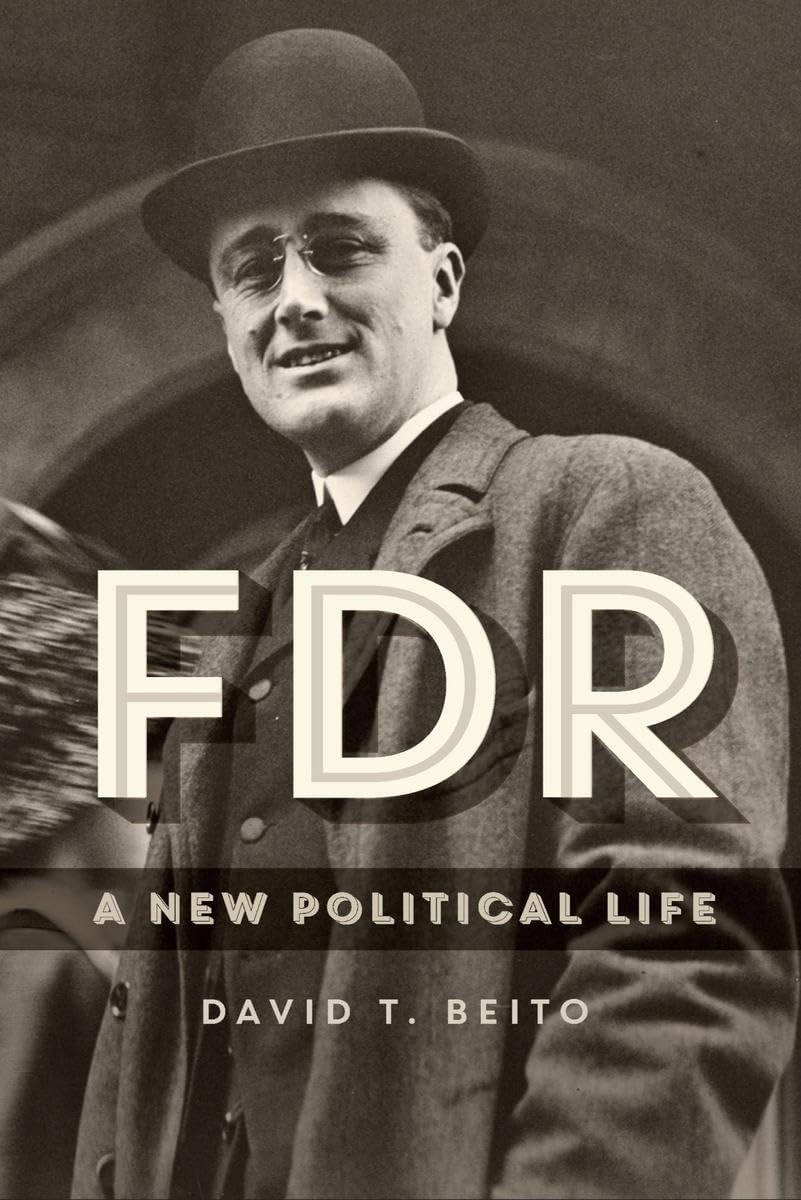
    So far, it's been an awesome trip, man. I'm in the process of (a) watching my portfolio at Fidelity; and (b) reading the book 1929 from Andrew Ross Sorkin, (Amazon link at your right.) And then I read this brutally honest article from Arnold Kling: The Value of Nothing.

    For the WSJ, T.J. Stiles writes,

    The 19th-century mental architecture of finance was concrete, built directly on the physical world. A share stood for a set amount of tangible stuff, which limited stock volume and value.

    Until very recently, people thought of the economy in tangible terms. In 1900, the price of gold in the United States was fixed at $20.67. The government stood ready to buy or sell gold at that price. It could only issue dollars to the extent that they were backed by gold.

    Today, the government can issue as many dollars as it needs to close the Budget deficit. Anchored to nothing, the value of a dollar is a consensual hallucination. We accept payment in dollars because other people accept payment in dollars. People are accustomed to receiving a particular amount of dollars each pay period, keeping a lid on inflation in spite of the ever-increasing supply of money.

    Disturbingly, the term "consensual hallucination" keeps popping up in Arnold's post. (Credited, even more disturbingly, to William Gibson in Neuromancer.)

    Arnold's bottom line:

    We are telling ourselves that we are wealthy. The government has borrowed money from us, and we expect to get paid. We own shares of stock, and we think that we can always sell them for a good price. It will all turn out fine in the end. Unless it doesn’t.

    Have a nice day.

    Still, what are you gonna do?

    (Andrew Ross Sorkin has plenty of examples of 1929's citizenry asking the same rhetorical question.)

  • [Amazon Link]
    (paid link)

    What in the world ever became of sweet Jane? Nick Gillespie usually does the interviews for Reason, but Sam Fakahany of the Freeman turns the tables and interviews Nick: Nick Gillespie’s Long, Strange Trip.

    FREEMAN: One thing I’ve been thinking about is that we at FEE are inheritors of a radical tradition. We just celebrated our 80th, and I don’t think the liberty movement realizes—or, rather, I think we sometimes forget—that we’re standing on the shoulders of giants. I’ve been rereading Radicals for Capitalism, and the late Brian Doherty spoke a lot about how libertarians always had this “bad-boy image,” that we reveled in our ideas being seen as wacko. But I’m not sure that’s true in the 2020s. When people say there’s no market for libertarianism, I think it’s because the big ideas—the ones Reason covered over the years, the ones FEE was founded to propagate—are now fully embedded in the mainstream.

    GILLESPIE: When did FEE start?

    FREEMAN: FEE started in 1946.

    GILLESPIE: You know, I think you’re right. Many of the basic libertarian principles that seemed to be insane and outlandish, especially when FEE started, are now completely accepted and taken for granted, or taken as the background and the starting point for conversation. And what’s interesting is that this tends to be more on the economic side than on the cultural side. We can talk about the cultural side in a minute, but you know, the early FEE pamphlets that made a splash featured arguments by people like Milton Friedman and George Stigler against rent control… The idea that in the late ’40s someone would be saying things like, “Well, rent control actually causes more problems than it solves. You can let markets decide not just what rental prices should be, but what the volume of housing should be…”

    Go back and look at people who are identifiably libertarian in the modern sense, Hayek and Mises in particular, and you’ll see that they were arguing for the basic idea that the market will produce a ton of stuff and bring, you know, sugar and salt and milk and eggs and butter to supermarket shelves, and in constantly better and more interesting and more varied ways. Nobody argues against that anymore. Even China has state capitalism; they don’t have state socialism anymore. And whatever else you can say about Zohran Mamdani and the Democratic Socialists, they generally agree that markets and free enterprise deliver a lot of goods. [What they argue] is that the distribution of this unbelievable bounty isn’t done properly. But that’s a fundamentally different argument from what proto-libertarians were encountering 100 years ago, or even 50 or 60 years ago.

    At the end of the ’90s, there was an economic show on PBS called The Commanding Heights, and it basically said that the 20th century was a battle between the ideas of Keynes and Hayek; they represented, respectively, a completely planned, heavily regulated economy, and more of a free market economy. I can still remember, I was watching this—I was living in Ohio at the time, I was on an exercise bike, and I literally fell off the bike when I heard the narrator say, “This was the battle of ideas in the 20th century, and Hayek won.” I was like, Wow, that’s pretty impressive.

    Another book I'm currently reading is (ye gods) an 824-page biography of Hayek. That only goes up to 1950! (And again, Amazon link at your right.) And, as I read, it's going into the Hayek/Keynes debate. Spoiler: see above for how it worked out.

  • It never hurts to be reminded… An excellent article from Timothy Harper: The Past Is a Guide — and It Points Toward Freedom. (NR gifted link)

    One hundred years ago, to celebrate America’s 150th birthday, President Calvin Coolidge gave a now severely underappreciated speech in which he responded to the new political movement of the time: progressivism. Progressives argued that social progress required abandoning the — as they viewed them — outdated principles of the Declaration of Independence and the Constitution. Coolidge responded that those principles were universal and final.

    “If all men are created equal, that is final. If they are endowed with inalienable rights, that is final. If governments derive their just powers from the consent of the governed, that is final,” Coolidge said. If one were to abandon the Declaration’s principles, “the only direction in which he can proceed historically is not forward, but backward toward the time when there was no equality, no rights of the individual, no rule of the people.” Justice Clarence Thomas, in a recent speech celebrating the 250th anniversary of the Declaration, summarized Coolidge’s point: “Progressivism . . . is retrogressive.”

    True in 1926, true today.

  • Back in my day, Buddhists just set fire to themselves. So I was surprised by nearly every word in this headline: Buddhist Chaplain at Tufts U. Resigns After Being Arrested in Prostitution Sting.

    Tufts Buddhist Chaplain Ven. Vineetha Mahayaye was one of seven men arrested on Saturday by the Boston Police Department’s human trafficking unit for allegedly attempting to pay for sexual acts. Mahayaye resigned from his position at Tufts, which he had held since December 2024, on Monday.

    Mahayaye, 32, pleaded not guilty and is set to appear in court on Sept. 2 on a misdemeanor charge of sex for a fee.

    Mahayaye allegedly responded to an advertisement posted by undercover BPD officers on a website frequented by sex traffickers, along with four of the other accused men. The advertisements were created as part of a larger sting operation called Operation Red Card, aiming to crack down on sex trafficking in preparation for World Cup games held in the Boston area.

    A 2025 article in the Tufts Daily profiles Vineetha in happier days. It contains the sentence:

    After 2 1/2 years spent living in the cave, Mahayaye felt ready to leave the forest.

    And also, I guess, felt ready for some nookie.


Last Modified 2026-06-21 12:02 PM EDT

It's a Stark Choice

The talking heads at New Hampshire's local TV station, WMUR, put together a segment on our state's motto:

That's not bad at all, but a tad superficial. The report implies that Stark's LFOD toast was original. He actually plagiarized, um, borrowed it from an older saying. (To be fair, as near as I can tell, he never claimed otherwise.)

If the WMUR newsies had read three paragraphs into the relevant Wikipedia entry…

By the time Stark wrote this, Vivre Libre ou Mourir ("Live free or die") was a popular motto of the French Revolution and was required as an oath of office for all legislators for the duration of the Constitution of 1791. A possible source of such mottoes is Patrick Henry's famed March 23, 1775, speech to the House of Burgesses (the legislative body of the Virginia colony), which contained the following phrase: "Is life so dear, or peace so sweet, as to be purchased at the price of chains and slavery? Forbid it, Almighty God! I know not what course others may take; but as for me, give me liberty or give me death!"

So suck it up, Granite State buttercups: our motto is French. They've even got a statue:

Of course, this was also around the time they started guillotining a bunch of people they didn't like.

Also of note:

  • There are so many lies, it's hard to keep track. But Erick Erickson describes a pretty bad one: The Two-Choice Lie.

    The pressure campaign is on. If you are on the right and you decline to salute the President’s deal with Iran, you are to be otherized — branded a warmonger, a neocon fossil, a man itching to put other people’s sons in the sand. The choice, we’re assured, is binary: boots on the ground or the President’s memorandum. That is a lie, and the people repeating it loudest know it is a lie.

    Start with the alternative they pretend never existed. Israel had a plan to destabilize the regime from within — and the President personally refused to allow it, at the behest of the Turks. Erdogan picked up the phone, and the option that wasn’t a land war and wasn’t surrender quietly disappeared. So spare me the two doors. There was a third, and Washington bricked it up to keep Ankara comfortable.

    I'm arguably a fossil, fine. I'll even take the "neocon" adjective, unless you consider it synonymous with "Jewish", then not.

  • They are the dogs that don't bark in the night-time. Or the daytime, for that matter. George Will wonders if their behavior will change: Perhaps Trump’s poodles in Congress will finally rouse themselves. (WaPo gifted link)

    Deferring gratification can be virtuous, but now is the time for an autopsy of Donald Trump’s presidency. The nation has experienced more than a few failing presidencies, but this flailing presidency is as uniquely unsightly as it is terminal.

    Trump’s plummet will intensify what is causing it, his self-absorption and self-indulgence. Recently, he has waged war carelessly, pursued a fixation incontinently, and named a building contemptibly.

    He unleashed America’s military competence, in conjunction with Israel’s, for a defensible purpose: preventing a genocidal and theologically demented regime from completing the Holocaust (it has called Israel “a one-bomb country”) and punishing God’s foremost enemy, America. But this worthy U.S. goal became a casualty of presidential frivolousness.

    That's not good.

  • It occurred to me that I didn't know exactly what "brimstone" was. But I know it's bad, when Kevin D. Williamson says The Vice President Is Playing With Fire (and Brimstone) (archive.today link) Expurgations in original:

    J.D. Vance’s conversion story is bulls–t.

    No surprise there: His last conversion story was bulls–t, too.

    The only halfway interesting part is that both stories turn out to be the same bulls–t: Vance’s story—once again—is that he put his faith in the wrong people and institutions and discovered the error of his ways at precisely the moment when doing so would do the most to advance his career.

    Saul had his great convulsion on the road to Damascus, but Vance, that knee-walking sycophant, had his somewhere in Cincinnati on his way to Washington, where he decided to take up the cause of Donald Trump, a man he had once described—accurately—as unfit for office, bag-of-hammers dumb, and an aspiring American Hitler, further insisting that at least some of Trump’s followers belonged in prison after the riot at the Capitol on January 6, 2021, a view of which he has lately repented. One could almost—almost—understand those who saw something in Trump back in 2016, but Vance saw the light only after the attempted coup d’état that crowned Trump’s four years of incompetence, cruelty, stupidity, venality, corruption, cowardice, laziness, pettiness, and dishonesty the first time around. One could imagine Vance concluding, circa A.D. 33, “You know, I didn’t think much of that Pontius Pilate guy at first, but he really showed me something with the way he crucified that troublemaker from Galilee while pretending to wash his hands of the matter—real shrewd politics, there.”

    So it turns out "brimstone" is just an old word for "sulfur". But "brimstone" sounds nastier, doesn't it?

  • Actually, I think it missed clarity altogether. Tevi Troy pans a recent direct-to-streaming movie: ‘Jack Ryan: Ghost War’ Misses Tom Clancy’s Moral Clarity. (WSJ gifted link)

    Fans of Tom Clancy’s bestselling thriller novels will unfortunately find little of Jack Ryan’s moral clarity in the latest film inspired by the series. “Jack Ryan: Ghost War,” one of the Top Five movies on Amazon Prime, follows CIA agent Jack Ryan as he tries to stop an MI6/CIA team created to fight Islamist terrorists. A pro-America version would make the team fighting the terrorists the heroes, but that isn’t the case in “Ghost War.” Instead, the villain appears to be the head of the post-9/11 antiterror task force, while the protagonists (led by Ryan) are people who want to shut the task force down.

    I'm pretty sure Tom would not approve. (Even though he got an executive producer credit on the movie, objecting would have been difficult, given that he's been dead for over 12 years.)

    The funny thing is (for sufficiently small values of "funny"): I watched that movie a few days ago (report here) and I had no idea about that "created to fight Islamist terrorists" thing. All I knew is the opening scene showed the Bad Guys murdering a bunch of folks that were (I'm pretty sure) clearly not Islamist terrorists.

  • If you're gay, and you know it, clap your hands. And then, if you live in California, grab a big bucket to catch that helicopter cash dropping from the sky. An excerpt from Nellie Bowles' TGIF column:

    → Certifiably gay: California’s regulated utility companies have earmarked $633 million only for contracts with gays. Yes, the state has put aside more than half a billion dollars of public utility money that can be spent only by those who have sex with their own sex. Well, how do you make sure they’re really gay? To qualify, California businesses can refer to a long list of gay-confirmation tests. One option includes: “Letter from three personal references attesting to the LGBTQ status of the business owner(s).” So you can get three friends to call you gay, and then you qualify for these government contracts. If they were serious, the requirement would be a sex tape. Also: The inclusion of B and Q is a pretty low bar here. Bisexuals? And queer just means a cool haircut with hair over your ears. This is our border wall? B’s and Q’s wandering in? Whatever, I wouldn’t need that to prove my qualifications; you just need to see how I walk kind of side to side, and hear my low voice, a voice that raises the question what went wrong in the womb. You would just need to play Melissa Etheridge and watch me come alive to know that I truly deserve one of those California utility contracts.

    Nellie's also pretty rough on Trump and J.D.


Last Modified 2026-06-21 6:48 AM EDT

The Postrel Challenge

I'm not a plastic-hater, but I feel obligated to point out the "Zero Waste Store", which will sell you (for $4.49 plus shipping) a Bamboo-Handle Toothbrush with "castor bean oil bristles".

Also of note:

  • Think of all the guillotines we could buy with the money taken from billionaires! At City Journal, Stu Smith looks at our local jacobins: The Democratic Socialists of America Just Adopted a Radical New Platform.

    Earlier this month, the Democratic Socialists of America’s top leadership met for an in-person meeting of their National Political Committee (NPC), the DSA’s governing authority. The result of the meeting was “Workers Deserve More!”, a rebooted platform for the organization featuring a host of radical proposals. The document commits DSA to scrapping the U.S. Senate, “abolishing the carceral forces of the capitalist state,” defunding the Department of War, amnesty for all immigrants, and “replac[ing] the President and Supreme Court with an executive and judiciary chosen by and subordinate to Congress.”

    Which sent me to Wikipedia's Graham Platner page. Fun Fact:

    Before running for office, Platner described himself on Reddit as a member of the Democratic Socialists of America who was "pretty radically left" and a "vegetable growing, psychedelics taking socialist" (in 2017) and "rabidly anti-Hillary [Clinton]" (in the 2016 Democratic presidential primaries).

    The office for which Platner is running is (you may have heard) the US Senate. Does he know that his buddies at the DSA want to scrap it?
  • My guess: it has something to do with the Strait of Hormuz. David Harsanyi's headline question: Why Is the Trump Administration Taking Orders from the Iranians?

    Why didn't President Donald Trump initially want to share the full text of the framework agreement between the United States and the Islamic Republic of Iran?

    The first reason is obvious: The memorandum of understanding is a capitulation to the clerics of the regime.

    The second reason is also a scandal.

    "I don't, frankly, fully understand it, but there are sensitivities that exist in the Arab and Muslim world that we're trying to be responsive to," a coy Vice President JD Vance told podcaster Megyn Kelly this week. But Vance, who helped negotiate the framework, added that the "Iranians, Pakistanis and Qataris asked us to sequence this in the right way."

    It's disgraceful that the administration is taking direction from the radical clerics of Iran and the Pakistani military dictatorship on the "right way" to share a "peace agreement" with the people.

    When it comes to Europeans, Vance always gets a thrill out of playing the tough guy, lecturing them on free speech and their cultural decline. No worries about the "sensitives" of the Germans or French, I guess. Bravo. In every way imaginable, however, Western Europeans are still freer and more moral than the Islamic Republics of Iran and Pakistan. Yet, Vance doesn't want to tweak the delicate feelings of Iranian Supreme Leader Mojtaba Khamenei.

    Harsanyi is pretty brutal on Vance and also Trump, who had previously promised Iranian protesters that "help is on the way."

  • We should not have been surprised. Because, as Jonah Goldberg points out: The Iran Peace Deal Is What Trumpism Looks Like. (archive.today link) Longish excerpt:

    You can divide the people who have invested great trust in Donald Trump into two camps: those who are an inclined plane wrapped helically around an axis and those who will become an inclined plane wrapped helically around an axis. Or to put it another way: There are people who have been screwed by Trump, and people who are destined to be screwed by Trump.

    Let’s flash back to March, when the anti-Israel and anti-“forever war” crowd felt “betrayed” by Trump’s Iranian adventure. I wrote, “The idea that Trump’s war on Iran is a betrayal of ‘True Trumpism’ is the last gasp of people who told themselves that Trumpism was an ideology. And it’s embarrassing.”

    The title of the piece was “The Iran War Is What Trumpism Looks Like.”

    Well, guess what? The Iran ‘peace’ deal is what Trumpism looks like, too.

    When a weathervane points north, we don’t confuse it for a compass. When the winds shift and it points south, we don’t say, “We’ve been betrayed!” We just say, “That’s what weathervanes do.” But an amazing number of people think Trump is more like a compass, pointing toward the True North of “America First” or “patriotism” or some other blather.

    Donald Trump has no ideological or moral compass. Or if he does, it doesn’t point outward toward any True North, but inward, toward himself.

    I was more disappointed than I was surprised.

  • For a lighter take, with more dirty words… Jeff Maurer pleads God Have Mercy: Iran is Poised to Become Delaware.

    Trump’s deal with Iran — call it the “JCPOS” — contains an endless parade of humiliations. And it’s not even the final deal: We’re entering a 60-day negotiating period, which will probably end with Iran annexing Texas, being given the recipe to KFC chicken, and renaming the Grand Canyon “The Infidel’s Vagina”. In exchange, Iran will agree to only use their nuclear arsenal against states that didn’t vote for Trump.

    One of the less-reported on parts of the deal is this: After the 60-day negotiating period, Iran currently retains the right to charge fees on ships traveling through the Strait of Hormuz. There were no fees before the war — this would be a major change. And if Iran turns the Strait into a toll gate, and a substantial portion of global shipping has to pay whatever fee Iran decides to impose, then we will enter a dark era: Iran will have become the world’s Delaware.

    For those who don’t live in the mid-Atlantic: Delaware is America’s Bridge Troll, a parasitic leech-state with an economy built on nickel-and-diming its neighbors. Driving virtually anywhere between Washington and New York requires driving on I-95, and the people of Delaware are the ruthless warlords of a 23-mile stretch of that 230-mile route. This is true even though I-95 is barely even in Delaware — the freeway would miss the state if Delaware’s uncircumcised tip wasn’t uncomfortably poking Pennsylvania:

    Jeff points out that Delaware is filching 43¢/mile from people zipping through their tollgates with an EZ-Pass. Compared to Maryland's 11¢/mile and New Jersey's 13¢/mile.

    Which made me look up our state's plunder for through travelers on I-95. Today it's $1.40 for our 16 miles, which works out to a mere 8.75¢/mile! What a deal!

    Ah, but some of our pols are looking to change that.

  • Other providers are finally catching up to Pun Salad. At least on this particular point:

    • John H. Cochrane, yesterday:

      The wealthy do not swim in Scrooge McDuck pools of money that can be handed out. And even if they did, that money, redistributed, would swiftly drive up prices rather than feed everyone. Musk’s trillion is not the ready inventory of a huge grocery store that can be handed out to feed people. And if it were, once the store was empty, the poor would be hungrier again, and there would be no store to buy from.

    • Tom Knighton, Wednesday:

      It’s pretty clear that many [people on the left] picture [Elon Musk] with a vault like Scrooge McDuck, where he dives in and swims in his trillion bucks, hoarding it all to himself, and keeping it away from the people who rightly deserve it or something.

    • Frank J. Fleming, last week:

    • David P. Deavel, last Sunday:

      Democrats like to paint a picture of the “rich” as if they were Donald Duck’s uncle, Scrooge McDuck.

    • Ah, but here's Pun Salad way back in 2014:

      But the image the "[money is the] most valuable [posession] of all" assertion brings to mind is Scrooge McDuck's daily swim in his Money Bin.

    That was in response to an ad for the "Future Leaders Institute" given by the University Near Here that summer. The title of that shindig was "Money, Greed, Corruption". I was kinda rough on their obvious money-is-so-icky slant, but I think it holds up OK.

    For what it's worth, the FLI is still around, although they are doing AI this year.


Last Modified 2026-06-19 11:26 AM EDT

Your Bible Verse du Jour is Ecclesiastes 1:9

But have I said that before? Probably. Here's the New International Version:

What has been will be again, what has been done will be done again; there is nothing new under the sun.

But the Bible Gateway has you covered if you'd like to see different ways of putting that. (Do not miss "The Message" version!)

Anyway: To go along with Mr. Ramirez's cartoon, we have Ramesh Ponnuru's take on Bernie's recent proposal. And (surprise) it involves giving the government more money and power: This absurd Social Security plan would take down progressives with it. (WaPo gifted link)

Sen. Bernie Sanders (I-Vermont) greeted the news that Elon Musk had become a trillionaire by — what else? — touting a plan to raise federal spending and taxes. Musk “pays the same amount into Social Security as someone making $184,500,” Sanders tweeted. He said his bill would “end that absurdity,” eliminate the program’s shortfall for 75 years and pay for an expansion of Social Security benefits.

[…]

But if it’s now okay to recognize the reality that Social Security redistributes money, why not reduce benefits for the well-off? Unlike higher taxes, cutting future benefit levels can spur people to work and save more, increasing the overall size of the economy. And there is plenty of spending on high earners to cut. Already the richest one-fifth of beneficiaries get 29 percent of the spending, and current law ensures that future retirees get bigger checks than today’s retirees do.

By the way: The party-poopers at the "Committee for a Responsible Federal Budget" crunched the numbers, and eliminating the tax cap would "extend solvency by just 21 years". (I.e., instead of going broke in 7 years, it would go broke in 28 years.)

Also of note:

  • Eschew numeric illiteracy! Take Ben Cohen's interactive challenge: You Have No Idea What a Trillion Dollars Is—and We Have Proof.

    That's a considerable amount of sobering fun, but for more sobriety and less fun, see Cameron Ewine at Unseen and Unsaid: Billion Dollar Rescissions Won’t Fix the Trillion Dollar Debt Problem.

    The United States’ gross federal debt of 39 trillion dollars has become so incomprehensibly large that many citizens and politicians alike now simply choose to ignore it. To put 39 trillion dollars into perspective, if every citizen, baby and grandma alike, paid their share of the debt, we would each owe roughly $114,000. All the while, with this looming debt rain cloud overhead, the current administration’s spending cuts target relatively small discretionary programs while allowing the largest spending categories to balloon in size.

    In FY2025 the federal government spent 7 trillion and brought in only 5.8 trillion in revenue. That 1.2 trillion-dollar gap is larger than the GDP of all but 19 countries. But instead of trying to rework the main drivers of debt such as entitlement programs like Social Security, Medicare, and Medicaid, our current government sticks to either targeting smaller, politically motivated cuts like the ones in the recent Rescissions Act of 2025 or performs fiscal judo in order to move spending from one area to another in disguise as budget cuts.

    The next time some pol proposes expropriating Elon Musk to pay for all sorts of goodies trickling down from the governmental teat, you can always point out that $7 trillion dollar yearly spending that hasn't done the trick of solving all our problems.

  • Did I mention that there's nothing new under the sun? Twenty years ago (June 18, 2006), Pun Salad invited readers to Meet the New Direction, Same as the Old Direction.

    So the Republicans have shown themselves to be largely incapable of spending restraint. Given the chance, they wet the bed on deficit reduction. They don't respect the First Amendment. They're unreliable friends of the free market. They love to stick the nose of the Federal Government into places in which it doesn't belong. And they love to stick the nose of the Federal Government into places in which it doesn't belong. And (did I mention?) they love to stick the nose of the Federal Government into places in which it doesn't belong. I could go on, but you get the point.

    All this makes me say to myself: time to become a Democrat. Then something happens to make me aware of the major flaw in that plan, which is: Democrats.

    The latest data point is the much-ballyhooed brand-spankin-new effort by the Democrats to put forward their 2006 manifesto, dubbed "A New Direction for America". This being Pun Salad, the first thing we must point out is: that title is a Emily Litella bit just waiting to happen. It's also very recycled, having been tried both by Dennis Kucinich and John Kerry during the 2004 election cycle.

    Most, if not all, of those links have rotted away. But the Wayback Machine squirreled away Nancy Pelosi's original "New Direction for America" press release, and check out the promises!

    Make Health Care More Affordable: Fix the prescription drug program by putting people ahead of drug companies and HMO’s, eliminating wasteful subsidies, negotiating lower drug prices and ensuring the program works for all seniors; invest in stem cell and other medical research.

    Lower Gas Prices and Achieve Energy Independence: Crack down on price gouging; eliminate billions in subsidies for oil and gas companies and use the savings to provide consumer relief and develop American alternatives, including biofuels; promote energy efficient technology.

    Help Working Families: Raise the minimum wage; repeal tax giveaways that encourage companies to move jobs overseas.

    Cut College Costs: Make college tuition deductible from taxes; expand Pell grants and slash student loan costs.

    Ensure Dignified Retirement: Prevent the privatization of Social Security; expand savings incentives; and ensure pension fairness.

    Require Fiscal Responsibility: Restore the budget discipline of the 1990s that helped eliminate deficits and spur record economic growth.

    Wikipedia has the results: "In a political revolution that ended more than a decade of Republican rule, the Democratic Party was swept into majorities of both chambers of Congress, governorships, and state legislatures. These elections were widely categorized as a Democratic wave."

    And all of that stuff Nancy promised was quickly accomplished!

It's All Good, Man.

I'm in the process of watching Breaking Bad episodes, one every few days, starting with Season 1, Episode 1. Saul Goodman, the sleaziest of sleazy lawyers, showed up a few days ago.

And his portrayer, Bob Odenkirk, got back into character to do a Public Service Announcement:

Also showing up [Breaking Bad spoiler: (from beyond the grave)] is the equally fictional, but not as sleazy, Mike Ehrmantraut.

And (sigh) Saul does not mention the right of the people to keep and bear Arms. But still, it's nice to see him again.

Just for the record, I had forgotten how much humor got dropped into the early episodes of Breaking Bad. Easy to miss, given all the violence, betrayal, lies, substance abuse, and general moral rot. But still.

Also of note:

  • Speaking of moral rot… What other way can you describe politicians who openly lust after "legal" plunder? Fortunately, as John Puri observes, Americans Aren’t Too Interested in Democrats’ War Against Wealth.

    My colleague Charlie Cooke likes to point out an eerie pattern among Democratic politicians: Progressives tend to “download” an identical new position or talking point in unison, as if receiving a software update to their programmed ideology, while acting as if it’s the most obvious and eternal truth in the world. Their latest patch has Democrats turning their scowls, in one synchronized sweep, toward America’s wealthy.

    Suddenly, Bernie Sanders and Alexandria Ocasio-Cortez are headlining the “Fighting Oligarchy Tour.” Support for a wealth tax is a litmus test for presidential hopefuls. Blue states are jacking up their top marginal tax rates. Insurgent candidates like Zohran Mamdani and Graham Platner are surging to primary success on platforms of white-hot rage against rich people and corporations, who they allege have rigged the U.S. economy. Mainstream Democrats have embraced their rhetoric. The progressive-activist class is genuinely enthused for the first time in a while — to defeat Republicans, sure, but even more so to grind the wealthy into the dust.

    There is nothing worse you can be in Democratic politics right now than a billionaire. Unless, of course, you’re a trillionaire.

    I know I quoted this guy a few days ago, but here you are again, excuser son sexisme à la française:

    When plunder becomes a way of life for a group of men in a society, over the course of time they create for themselves a legal system that authorizes it and a moral code that glorifies it.

  • Worse than Neville Chamberlain. Erick Erickson says it well: A Peace Worse Than War.

    Donald Trump started a war with Iran, and now he is ending it on terms worse than the status quo he inherited. That is the plain shape of what happened, however the White House and its surrogates dress it up.

    The war came at a price—lost lives, oil markets convulsing, allies rattled, and an economic shock that rippled from Tehran to global commodity prices. What started as a strong campaign to end a regime is ending with subsidy and surrender by the Americans. We are choosing to give up.

    And Andy McCarthy agrees, but can't help but point out what it says about the relationship between the Administration and its subjects: The Trump Administration Thinks We’re Imbeciles. (archive.today link)

    Let’s take it down to the simple basics. Trump’s agreement with Iran is not an agreement, it’s a memorandum of understanding (MOU), reportedly stating that the parties will talk about making an agreement, for infinitely extendable 60-day limits. That is, other than the billions to which the Trump administration has agreed to give the implacably anti-American jihadist regime, the MOU is a nothing that Neville Trump is peddling as peace in our time.

    But to the extent the MOU is something, it is something very bad because if it were something good, we’d be reading it, not being spun about it.

    The president is an impetuous man who would not be able to contain himself if the written MOU were of even marginal benefit to the United States; he would be far more comfortable exposing it and exaggerating the marginal benefit as if it were a coup. The fact that the Trump administration refuses to publish the MOU — refuses even to brief the Gang of Eight on it — is powerful implication that it is at least as bad as close watchers suspect it is.

    How many 2024 Trump voters now wish they had their votes back?

  • While we're at it… Kevin D. Williamson has a suggestion: We Should Probably Stop Murdering People. (Dispatch gifted link)

    Acting on orders from President Donald Trump, the U.S. military has murdered Héctor Rusthenford Guerrero Flores, popularly known as Niño Guerrero, a Venezuelan drug trafficker and leader of the Tren de Aragua crime syndicate.

    This was—and ought to be treated as—a straightforwardly criminal act on the part of the American president and those who have carried out his illegal orders. Guerrero Flores had been charged with federal offenses under U.S. racketeering conspiracy laws. But there is no law authorizing summary execution of drug-crime suspects. There is no congressional authorization to carry out military attacks in Venezuela. Guerrero Flores may very well be everything the Trump administration says he is and more—though under the Trump administration the word of the White House is no more reliable than the word of a South American drug dealer—but, even if that were the case, there is no legal authorization for the preemptive extrajudicial killing of crime suspects. The Trump administration explains that it has “determined” that the United States is at war with drug cartels and that Guerrero Flores, like the boatloads of civilians the U.S. military has been massacring at sea for months, is a “combatant.”

    Impeachable.

Iran, So Far Away

[Amazon Link]
(paid link)

Take it away, Andy McCarthy: Trump’s Iran Deal: Billions Up Front for Leading State Sponsor of Terrorism. (NR gifted link)

Not surprisingly, the Trump administration is still not publicizing its memorandum of understanding (MOU) with the jihadist Iranian regime.

It is laughable, of course, to speak of an agreement (or “understanding”) with Iran, which has a long, undeniable history of breaking agreements, in particular about its nuclear weapons ambitions. And while President Trump either doesn’t grasp or can’t be bothered to address the regime’s ideology, a core principle of sharia supremacism, including Iran’s Shiite version, is that lying to the enemy is a key part of warfare (“War is deception,” said Islam’s prophet in an oft-quoted hadith). This, for example, is why — even as the overwhelming evidence shows it was advancing its nuclear weapons program — the regime insisted that its leader, the now-departed Ayatollah Ali Khamenei, had issued a fatwa (a sharia law edict) against nuclear weapons. This would have been hilarious had not the Obama administration adopted it as part of its rationalization for the Joint Comprehensive Plan of Action.

It appears I was wrong about this being a good idea. It appears to have been a stupid idea, ineptly carried out, an expensive failure that leaves us worse off than before.

Yes, we managed to blow up some bad guys. I don't think we blew up enough of them.

Also of note:

  • In other stupid news… James Bacchus analyzes Trump's Trade Delusion: Why Dismissing Canada and Mexico Echoes a Dynasty's Downfall.

    In yet another of his unending twists on trade, President Donald Trump has suggested he may not renew the current United States trade agreement with Canada and Mexico. Especially interesting was one of his explanations of why. “We don’t need anything that Canada has; we don’t need anything that Mexico has, but they need everything that we have, and they have to treat us better,” said Trump. “We don’t need their cars; we don’t need their lumber; we don’t need their energy; we don’t need anything that they have.”

    According to the numbers from April of this year, Canada is the leading trading partner of the US in imports and exports of goods, totaling $86 billion. Mexico ranks second, totaling $64.8 billion in two-way goods trade with the US. Overall, the regional economic integration of the United States–Mexico–Canada Agreement (formerly the North American Free Trade Agreement before Trump made a few changes in it and relabeled it as the USMCA in his first presidential term) has made all three parties to the agreement more competitive domestically and internationally.

    Are you comfortable with any president decreeing what the American people "need"? Especially when that conflicts with the preferences they express in voluntary, peaceful marketplace exchange?

  • Looking at a different clown at a different circus. Matthew Hennessey attended so you didn't have to. And in observing one clown, concluded: Robert De Niro Hates America.

    While crowds on the White House lawn were cheering the Navy Blue Angels and Air Force Thunderbirds Sunday night, actor Robert De Niro was strafing his once-beloved country.

    His Committee for the First Amendment staged a resistance concert/rally at a small theater in New York. The anti-Trump Committee calls itself “a large collective of artists, storytellers, and cultural leaders.”

    Before going any further I want to register my absolute disgust at the use of the word “collective.” Be a group. Be an organization. Don’t be a collective. It makes you sound like a bunch of communists. I realize some of Mr. De Niro’s friends might not mind leaving that impression. They should.

    The Committee is composed primarily of entertainment-industry types. They say they are “standing together to defend free expression against government repression, industry complicity, and intimidation.” That’s a serious mandate. You might even call it self-serious.

    I may have said this before, but: De Niro deserves an Oscar. For any movie in which he portrays a decent human being.

  • Speaking of collectives… Erick Erickson looks at the reaction to the SpaceX IPO: The Committee Cannot Forgive a Verdict It Didn’t Cast. Erick notes, as Pun Salad has, the IPO's creation of 4,400 new (on paper) millionaires. And also that one trillionaire, Emmanuel Goldstein Elon Musk.

    Instead of celebrating the broadest single-day creation of working-class wealth in living memory, the prominent voices of the Left reached for the pitchfork. Elizabeth Warren, who had already begged the SEC to delay the offering, announced that the typical American household would have to work “more than 11 million years” to match Musk, and demanded a wealth tax.

    Bernie Sanders denounced Musk and his “fellow oligarchs,” dusting off the 5 percent annual wealth levy he and Ro Khanna have floated for months.

    Ro Khanna pronounced the system “rigged.” “Wall street folks are celebrating Elon Musk for creating 4,400 millionaires. Fine. Did any of them celebrate Joe Biden IRA, ARP, CHIPS for creating millions of good paying jobs? Our barometer should be opportunity & stability for the majority, not simply wealth for the few,” Khanna tweeted. Those programs, by the way, have only created 335,000 jobs so far, with most being generous long term projections and done by putting the American public further into national debt, driving up costs to our children. Also, we should remember that when Pete Buttigieg was handed billions of dollars to build roads and bridges, he decided to use the money, instead, to tear down systemic racism.

    Erick goes on to look at the Iran "deal", and he's not a fan either.

  • Looking for a pony in this room filled with manure? Sorry, the best I can do is Matt Ridley, who has a little good news: An amateur sleuth is singlehandedly demolishing dangerous scientific groupthink.

    Sholto David is a Newcastle University graduate who has made a name for himself as a “scientific sleuth”. Last year, he brought a case against the Dana Farber Cancer Institute in Boston that resulted in a $15m (£11m) settlement of fraud allegations with the US Department of Justice.

    Now he has found an astonishingly amateurish error in cancer studies across the world. The implications for public trust in science of this and other scandals are increasingly alarming.

    In hundreds of studies that David looked at, scientists claimed to have found an effect on a tumour-suppressing gene called p16-INK4a, but had instead ordered the wrong antibody from commercial suppliers. They had bought an antibody that detects the activity of a different and irrelevant gene called p16-ARC, probably because it’s listed alphabetically first in the online catalogue.

    As a result, teams of scientists from Oxford, Cambridge, Stanford, Johns Hopkins, and even Wuhan have published results—often in high-impact journals—that make no sense. Yet the experts involved often claimed to have validated their hypotheses anyway.

    You may know that Mark Twain didn't say, "Never read medical books. You might die of a misprint." Today's corollary is: "Never believe medical studies. You might die of a mistaken antibody order."

    But going back to Matt's first paragraph:

    I've given Dana-Farber/Jimmy Fund (what I consider to be) a decent sum of money over the years.

    However, that sum is a drop in the bucket compared to the $15 million that Dana-Farber had to pay the Feds.

    But in other news, I gave enough to get an invite to a free Red Sox game against the Nationals later this month. The Sox are firmly in the basement of the AL East standings, but I hope to have a good time anyway.

Famous Author Subtly Snarked At

For the record:

  1. I'm not a Trump voter;
  2. It's only been a couple days since I said mean things about the intelligence of:
    1. New Hampshire GOP primary voters and
    2. Maine Democrat primary voters.
    Want to argue about that? Get back to me once you've read Bryan Caplan's The Myth of the Rational Voter.
  3. Despite how I sometimes sound, I'm a fan of epistemological humility.
  4. Another Feynman quote: "Science is the belief in the ignorance of experts."

Also of note:

  • "And you can believe me, because I never lie, and I'm always right." I can't believe Jacob Sullum wrote this with a straight face: Trump's lawyers insist there is 'no evidence' of 'collusion or fraud' in his 'settlement with myself'

    "I'm supposed to work out a settlement with myself," President Donald Trump told reporters a few days after he sued the IRS. He wasn't kidding: His January 29 lawsuit, which alleged damages from an IRS contractor's illegal leaking of his tax returns, pitted Trump against an agency he oversees, represented by Justice Department lawyers who also answer to him.

    The "settlement" that the president reached with himself, which Acting Attorney General Todd Blanche announced on May 18, included $1.8 billion in taxpayer money for purported victims of the Biden administration's "lawfare and weaponization." It also included protection from liability for tax violations and any other federal offenses that Trump or his family might have committed. That sweet deal was business as usual at the Justice Department, Trump's personal lawyers improbably claim in a brief they filed on Monday in the Southern District of Florida.

    There is "no evidence" of "collusion or fraud" in Trump v. IRS, Alejandro Brito and two other lawyers told U.S. District Judge Kathleen Williams, who last month ordered briefing on that issue. Any suggestion that Trump used a phony lawsuit as a pretext to obtain huge favors for himself, his relatives, and his supporters is based on "nothing but speculation," Trump's attorneys say.

    Could we just impeach him already?

  • Reminding me of Buckye Newshawk Winner Les Nessman… [At a news conference with a Soviet agriculture delegation, where he and Bailey Quarters are the only attendees: "Yes, I have a question… What I'd like to know is … who do you think you're kidding?"]

    Similarly, Jeffrey Blehar's headline asks: Who Does Donald Trump Think He’s Fooling?

    On Thursday, Donald Trump announced the cancellation of a threatened round of airstrikes against IRGC positions in Iran, due to be launched in retaliation for a series of attacks on our regional allies. Once again, talks were about to be reopened, a marvelous “deal” was about to be signed and the war ended. “Time and place of the signing to be announced shortly.”

    And pretty much everyone rolled their eyes and ignored it. “More mush from the wimp,” was my reaction, recalling a famous Carter-era Boston Globe headline. This circus — threatened strikes, strikes called off for talks, Iranian forces still shooting missiles at us and our allies — has been going on for months now, and here we go again.

    But apparently it was for real, and few at this point doubt Trump’s desperate eagerness for a “deal” of any sort to extract him from a self-inflicted geopolitical blunder of lasting consequence. And Iranian media leaked the Iranian side’s claims about the “terms” of the deal: a series of claims so scandalous — nationalization of the Strait of Hormuz, release of billions in restricted cash flows, and yielding to Iran’s claims in Lebanon under the flag of Hezbollah — that as our own Noah Rothman wrote, agreeing to them would be tantamount to admitting defeat. The Iranians were obviously playing their own propaganda game in leaking these nonsensical terms, but they’re setting absurdly high demands — in a war Donald Trump keeps insisting they lost — because they know they hold the winning hand: They can play out the string for years if they want to, and they’ve done it before.

    (Also) Apparently, it's a done deal.

  • Not going to make it into the new edition of Profiles in Courage NHJournal's Michael Graham watches a local pol's flip-flop: #MeToo No More? Hassan Slammed Kavanaugh, Franken but Silent on Platner.

    New Hampshire U.S. Sen. Maggie Hassan was first sworn into office in January 2017. That October, the #MeToo movement exploded into the mainstream public consciousness after the wave of revelations about liberal Hollywood producer Harvey Weinstein.

    Hassan promptly jumped on board, embracing the “Believe all women” attacks on U.S. Supreme Court nominee Brett Kavanaugh, and calling for the resignations of U.S. Sen. Al Franken (D-Minn.) and New York Gov. Andrew Cuomo.

    But in an interview with WMUR’s Adam Sexton that aired Sunday, Hassan took a notably different approach to Maine Democrat Graham Platner.

    The two-term Democrat acknowledged Platner’s problematic behavior, but she repeatedly refused to say if she would support or denounce his U.S. Senate candidacy.

    Did she use the "let the voters decide" dodge? Sure did:

    “I think the people of Maine have a lot to balance, and they ultimately need to make that decision,” Hassan said.

Recently on the book blog:

Blank Space

A Cultural History of the Twenty-First Century

(paid link)

I've seen people talk about "hate-watching", consuming media (typically TV or movies) that you despise. For some reason. Well, this book by W. David Marx turned into a "hate-read" for me. And my "reason" is pretty lame: I have a self-imposed rule to read every book I check out of the library, bad or good.

The usual disclaimer: I'm not a reviewer. My only goal is to write a "book report", like the ones I used to write for Mrs. Kluska back in fifth grade. And I'm just reporting my personal reactions; I wouldn't be surprised if yours were totally different. (For example, the WSJ reviewer, Dominic Green, was just complimentary enough to put the book on my get-at-library list.)

Although I've lived through the same quarter-century, and lived in the same country, that Marx claims to be chronicling, the main thing I noticed from nearly page one was how little of the "culture" discussed had any lasting impression on me, one way or the other. Indeed, the pages are filled with names and events that I had never heard of. And, often, when I had heard of them, I hadn't actually partaken. (For example, I'd heard of the song "Old Town Road", but I've never actually listened to it.)

Mostly, I had to wade through stuff like this, about "SoundCloud rappers": "These tools launched a new wave of hip-hop stars-Lil Yachty, Lil Uzi Vert, Lil Pimp, Lil Peep, Playboi Carti, XXXTentacion, Juice WRLD, and 6ix9ine." And page after page about something called "streetwear". Which I think is some sort of clothing. Scanning the index for who and what Marx deems worthy of attention: Beyoncé, Justin Bieber, Lena Dunham, Facebook, Paris Hilton, Jay-Z, Taylor Swift, Kanye West, Pharrell Williams, … And many assorted Kardashians and Jenners.

The author's political biases occasionally show up: gratuitous swipes at "capitalism" and "neoliberalism" appear every so often. The "Steele Dossier" is simply described as "filled with unverified claims about Trump's ties to Russia". Unverified? I'm pretty sure a more accurate adjective would have been "fake". Kyle Rittenhouse is described as someone "whose entire life accomplishment was crossing state lines into Wisconsin with an AR-15—style rifle, killing two protesters and being acquitted." I (like the National Review editorialists) think the jury got it right.

To be fair, there are plenty of "right-wing" loons out there that deserve criticism.

On the other hand, I don't think Marx mentions Jussie Smollett at all.

And AI? Marx comes off as a kind of curmudgeonly Luddite: 'AI companies vowed to end the evil monopoly of pernicious creators who dared take the time to make things with a sense of craft and intention."

Marx winds up with some recommendations about how to improve the culture. I'm unsure about their efficacy.

Should Have Seen This Coming

[Amazon Link]
(paid link)

A rare above-the-fold twofer from Erick Erickson on this fine Flag Day. First up is The Beclowning of a President, from Friday June 12.

The President, the other days, said Iran was playing us. The only one being played is President Trump. A state of war exists between Iran and its neighbors. The ceasefire is a farce. The President has turned into a clown.

It is Obamaesque to think one can negotiate with a terrorist regime that is premised on bringing about the apocalypse. The Vice President claims the Trump Administration is dealing with both moderates and hardliners. The definition of a moderate in Iran is one who wants to nuke Israel tomorrow, instead of today.

The President of the United States chose to engage Iran. It dealt a serious blow. But instead of dealing a knock out blow, the President ordered Israel to pull its punches. We have now harmed our relationships with our Middle Eastern allies who depend on us for protection. The situation is now more unstable than before the war began and it is all because of a single person who swears he’ll get a deal any day now.

The President should be embarrassed. Instead, he’ll be mad at everyone except the man in his mirror.

Ah, but maybe Erick should have waited until more facts were revealed? Until the four-dimensional chess moves finally became clear?

Nah. Erick's take yesterday, Saturday June 13: A Clown Show Still. Problems:

First, Iran and Oman would share a “service fee” for ships passing through the Strait of Hormuz. That is new and would provide regular funds to Iran. While Saudi Arabia and the United Arab Emirates can divert some, not all, of their oil flow via pipelines, some of their oil still flows by ship. Kuwait, Bahrain, and Qatar overwhelmingly ship their oil by boat.

This will be a new and novel revenue stream for Iran.

Second, anything having to do with Iran’s nuclear program will be deferred for later talks. As I am writing this, Iran is hard at work laying mines and otherwise actively taking steps to block access to its nuclear materials.

Third, the United Arab Emirates, despite denials, does appear ready to transmit a few billion dollars to Iran. The UAE is quibbling over the wording of what money goes to Iran, but has not actually explicated denied any transfer of funds to Iran.

I do not know why it is so hard for President Trump to understand that, having provoked this war, he cannot now end it with Iran in the position Trump has left that nation.

Erick's bottom line is sobering, to say the least:

The United States won a war and appears now willing to lose it and allow its enemy — which has killed thousands of Americans for years — to rearm and nuclearize.

Joe Biden handed Afghanistan back to the Taliban.

Donald Trump intends to embolden Iran’s quest for the apocalypse.

I stand by what I wrote yesterday. The President is beclowning himself.

And as befits a clown, he's offering us a circus. Cheers!

Also of note:

  • Anyone notice the real inequality here? Veronique de Rugy looks at The Paris-to-Sacramento Pipeline: How Three Economists Built a Blueprint for Taking Your Stuff.

    A coordinated agenda to impoverish rich countries and keep poor countries poor in plain sight.

    There is a pattern that’s worth naming. Over the past several years, three French economists — Thomas Piketty, Emmanuel Saez, and Gabriel Zucman — have together produced a body of work that functions less like independent scholarship and more like a coordinated legislative program. Understand the logic of each piece, and the larger design becomes visible: a vast wealth-tax net drawn tight enough that no one can escape it, not by moving to Nevada, not by renouncing citizenship, not by relocating a business. Global, compulsory, enforced. For what goal? To level countries down.

    They have told you that this is the goal. Believe them.

    The real inequality? It's power: the difference between (1) us and (2) the people carrying out this legal plunder.

    You-know-who said it well:

    When plunder becomes a way of life for a group of men in a society, over the course of time they create for themselves a legal system that authorizes it and a moral code that glorifies it.

    Nellie Bowles takes a more sarcastic look at the Picketty plunder proposal in her TGIF column:

    → This is where the green movement has gone: The hugely popular economist Thomas Piketty, the guy everyone in college read and quoted, is out with a big new proposal to completely flatten and stop growth. That’s it! That’s the innovation! To end innovation. It’s supposedly how we will tackle climate change. Rich countries would be de-riched through a global wealth tax. Degrowth for all, mangoes in winter for none. The money would be transferred to a Global Justice Fund that would handle massive resource transfers to get us all, globally, at the same level of poverty. Hipster economists all banded together to announce their new scheme:

    We economists have done the maths! As Ross Douthat puts it: “Worth noting that this is basically Peter Thiel’s vision/fear of the Antichrist—the soft slipper of bureaucratic degrowth environmentalism on the human face, forever.” Maybe I need to watch one of Thiel’s Antichrist lectures. Yes, economists have gathered together and decided that it would be best for all of us if we just died—not immediately, but soon. Just slip away. On a serious note: Thank god the white supremacists are always losing because if the world were run by delicate Europeans like Piketty, we’d be very conscientiously, very articulately, told to hold hands and jump off a cliff.

    You first, Tom.

  • One can only laugh. Your only other option is to weep bitter tears. Noah Rothman notes: Obama Alum Mourns How Effective Their Social Security Demagoguery Was. (NR gifted link) He is more than a little miffed at this sort of thing:

    How did we find ourselves in this predicament? Furman’s cursory historical review fails to uncover a culprit. Perhaps his investigation was hindered by his obvious conflict of interest. After all, the problem Furman laments has been dutifully cultivated by the political party to which he has devoted himself.

    Democrats spent decades demagoguing the issue of Social Security reform, attacking anyone who dared notice the program’s documented shortfalls. It was a reckless and irresponsible political messaging campaign. But it was also a wildly successful one on the Democratic Party’s own terms.

    Recall how Democrats reacted back in 2005 when George W. Bush proposed allowing workers to divert just 4 percent of their payroll taxes into personal retirement investment accounts. Furman’s former boss, the 44th president, accused Bush of attempting to “privatize Social Security and gamble your retirement.”

    As noted here a few days ago; in my local race for US Senator, there are no candidates willing to come out in favor of making "hard choices".

  • You deserve a break from all this grim news. Dave Barry is here for that: Your Biological Age.

    Recently I became concerned about zinc. This happened because of an article I stumbled across on EatingWell, an educational website devoted to making the act of consuming food, which most of us perform every day, seem as complicated as the United States Tax Code, but more threatening. Whatever you’re eating, and whatever way you’re eating it, I can pretty much guarantee you that according to the experts at EatingWell, you are doing it in an incorrect, and possibly fatal, manner.

    And I’m not just talking about food. I’m also talking about water. Yes. It turns out that consuming water is a complex and potentially hazardous activity that probably should not even be attempted by untrained civilians such as yourself without expert supervision, as explained by the many, many articles EatingWell has published on this topic. Here are just some of the headlines (I am not making any of these headlines up):

    Is Water Good For You?

    Here’s How Much Water You Should Drink Every Day, According To Dietitians

    What Happens to Your Body When You Don’t Drink Enough Water

    This Simple Change to My Daily Routine Turned Me into a Water Drinker

    The Benefits of Front-Loading Your Water Intake, According to Dietitians

    What Happens to Your Skin When You Don’t Drink Enough Water in the Day

    Didn’t Drink Enough Water During the Day? Here’s What You Can Do Tonight

    Should You Be Drinking a Glass of Water Before Bed? Here’s What Dietitians Have to Say

    Should You Be Drinking a Glass of Water When You Wake Up? Here’s What Health Experts Say

    Should You Drink a Glass of Water After You Work Out? Here’s What Experts Say

    I Drank the Recommended Amount of Water Daily for a Week — Here’s What Happened

    Here’s What Happened When I Drank More Water for 30 Days

    4 Signs You’re Drinking Too Much Water

    When Did We Get So Fixated on Hydration?

    And there are plenty more EatingWell articles about water. There’s one that’s nearly 1,000 words long devoted entirely to the question of — I am still not making this up — whether it’s OK to drink from a glass of water you left sitting out overnight. (Spoiler Alert: It’s “probably OK,” but “with a few caveats.”)

    The late Mrs. Salad was a Registered Dietitian, and a longtime professor of nutrition at the University Near Here. And one of the things I miss most about her is sharing Dave Barry's stuff with her.

Apt, Because It Comes Out Red or Blue

Glenn Reynolds on his substack avers: Elon Musk is a Genius, and a Litmus Test. Among the tweets Glenn surveys:

Glenn:

"There shouldn’t be trillionaires” is junior-high-level stuff. We should have people producing trillions of dollars in value for society. The argument that Elon should be spending his money on “feeding the hungry” is stupid in a country where the federal government spends multi-trillions a year on just that, with dubious results. It also betrays either a notion, or a lie, based on Musk having a Scrooge McDuck style Money Bin with a trillion dollars in it. In fact, of course, he owns assets that are busy producing useful things, not cash just lying around somewhere going to waste. Most of the people pretending otherwise know better, but hope their listeners don’t. The rest are just imponderably stupid.

And, as many people pointed out: The SpaceX IPO made millionaires out of about 4400 employees. Compared to the millionaires created by Elizabeth Warren and Bernie Sanders: One. Each. Themselves.

Also of note:

  • His putative product is progressive-populist rage, and that's boring. David Harsanyi is unimpressed by the man behind the massive character flaws: Even Without His Controversies, Graham Platner Is Just a Lightweight Extremist.

    Set aside, for a moment, that Maine Senate candidate Graham Platner spent years with a Nazi SS Totenkopf tattoo. Set aside that he blamed sexual assault victims for their predicament, that he called rural white Americans stupid racists, that he advocated political violence, that he mocked a wounded Purple Heart recipient, that he joked about the Virgin Mary being a "skank" and that he joined a hookup site while married.

    Who among us is a saint, after all?

    The more interesting question is why Democrats have shown such loyalty to him.

    After hearing so much about Platner's everyman appeal, I went down a rabbit hole, watching his speeches and listening to his interviews. Virtually every one of them is crammed with brain-numbing platitudes and freshman-level socialist sloganeering. His rhetoric makes former Vice President Kamala Harris sound weighty by comparison.

    152,859 Maine Democrat primary voters can't be wrong… Oh, wait, they can definitely be wrong.

    Oh wait…

  • It's (yet another) plague on both houses day. Kevin D. Williamson has A Question for Republicans. (archive.today link)

    The largest factory fuel tank on a Ford Super Duty truck holds 48 gallons. In my neighborhood, the average price of a gallon of diesel over the past month has been $5.60.

    Do the math.

    You see a lot of Trump bumper stickers on those big diesel trucks. And when the total at the pump hits $270 to fill up that truck, I want to ask the gentleman paying the bill:

    “Do you feel smart?”

    I can look at my Nikki Haley campaign memorabilia (one pictured at your right) and maybe feel a little smarter than 176,392 of my fellow GOP primary voters. But not especially happy about that.

  • What's on the menu tomorrow? You, probably. Veronique de Rugy writes bleakly at Civitas Outlook: Eating the Rich, Ending Civilization.

    There’s something that should unsettle anyone who thinks carefully about a free society, and it has nothing to do with tax rates or revenue projections. It’s the cheerful ease with which large numbers of otherwise decent people have concluded that what belongs to someone else really belongs to others and is, in principle, available for redistribution. The only serious question is how much to take.

    I am not primarily troubled by bad tax policy, though there’s plenty of that on offer. I am troubled instead by something deeper: a growing popular instinct that treats the accumulated wealth of others as a kind of commons, a shared resource somehow misallocated to private parties who did nothing to earn it, resulting in a faulty income distribution that needs to be corrected. Watch the polling. Listen to the applause lines. The enthusiasm is real, not reluctant. People are not grimly accepting a necessary evil. They are genuinely excited about the prospect of taking the fruits of what someone else built – what someone else has earned.

    This lust for other people’s money should disturb us.

    Well, it does disturb some of us. And I keep coming back to the sentence I copied out of Hayek's The Constitution of Liberty (1960):

    That a majority, merely because it is a majority, should be entitled to apply to a minority a rule which does not apply to itself is an infringement of a principle much more fundamental than democracy itself, a principle on which the justification of democracy rests.

  • Do you Google, bunkie? Yes? I do too! Robert F. Graboyes has accumulated a trove of useful tricks and techniques for the Googler: 50+ Ways to Stop Using Google Like Truck-Stop Gamblers Use Slot Machines.

    Most of us do Google searches like some truck-stop gambler yanking the arm of a slot machine —find a loose search term in your pocket, drop it in the machine, pull the handle, watch the wheels spin, and hope for three cherries and a cascade of silver dollars. More often, the result is a cherry-lemon-bell list of hits that barely fit your needs (if at all) and which are heavily laden with sponsored content—websites that pay Google to steer your searches in their direction, even if they’re not what you want. With a modest number of tricks—offered in the paragraphs below—your searches can become less one-armed bandit and more world-class poker.

    I was inspired to write this after reading Card Catalog Substacker Hana Lee Goldin (MLIS)’s itemized list of tools in her 4,000-word essay: "Google Has a Secret Reference Desk. Here's How to Use It."

    Some of the tools/tricks/tips I knew, many I did not. For what it's worth, he did not mention one I use a lot: unit conversion.

    For example, do you want to know what 70 miles per hour in billionths of the speed of light is?

    A speed of 70 miles per hour is equal to approximately 104.38 billionths of the speed of light.

    One of my really crackpot ideas is to convert speed limit signs (and of course vehicle speedometers) to "nanocees", shorthand for "billionths of the speed of light." So (rounding a bit): take down that "Speed Limit: 70 mph" sign, and put up "Speed Limit: 104 nc".

    Metric system proponents are always jabbering about how easy the metric system makes calculations; this would make relativistic time-dilation calculations much easier!

This Reminds Me of a Joke.

[Sam as All-Star]

Let's put Mr. Jefferson at second base. Reason's Ron Bailey explains Why Thomas Jefferson is the most fascinating Founding Father.

"Rightful liberty is unobstructed action according to our will, within the limits drawn around us by the equal rights of others," wrote Thomas Jefferson in 1819. This accords well with the Cato Institute's definition of libertarianism: "the belief that each person has the right to live his life as he chooses so long as he respects the equal rights of others."

Immediately following his definition of rightful liberty, Jefferson properly cautioned, "I do not add 'within the limits of the law'; because law is often but the tyrant's will, and always so when it violates the right of an individual."

Like any good baseball scout, Ron is honest about TJ's major flaws involving that Peculiar Institution. But the bottom line:

Jefferson's hypocrisy with respect to slavery is a blot on his legacy. But he still deserves our praise for expressing the principles and framing the institutions that enabled the eventual extension of civil and political rights to all American men and women. On the anniversary of Jefferson's Declaration, it is up to us to sustain and extend that document's ideals.

Oh, by the way, that joke mentioned in the headline is here. Probably not the safest one to tell in mixed company.

Also of note:

  • "Dr. Fieseher, a Mr. D. Bunker is Here to see you. He doesn't have an appointment." A couple days back I mentioned an op-ed column in my lousy local newspaper from Dr. James Fieseher. He bemoaned the sorry state of American healthcare and pointed the shaky finger of blame at insurance companies. Excerpt:

    Health insurers claim to add value by “managing” our healthcare. But is that really a value? Their idea of managing is to intervene in the doctor-patient relationship and decide, without having a medical degree or having seen the patient, which medications or procedures prescribed would be paid and which are unnecessary.

    Fieseher also claimed "health insurers are among America’s richest and most profitable companies and their CEO’s are paid among the highest salaries …"

    Which made me pay attention to a recent post by economist Noah Smith, which claims: Insurers aren't the main villain of the U.S. health care system. Some truth dropped along the way:

    Everyone knows that denying claims is in the insurance company’s financial interest. The more they can get away with taking your monthly premium and then weaseling out of their end of the bargain, the more their shareholders and executives can walk away with giant bags of money. They’re the ones buying huge houses and yachts and whatever on the money they made from finding some technical reason to send you and thousands upon thousands of people like you into medical bankruptcy after your chemotherapy. Who wouldn’t be mad?

    And yet when we take a hard look at the question of why Americans pay so much more for their health care than people elsewhere in the developed world, insurance companies and their profits just aren’t that big of a piece of the story.

    First of all, insurance companies just don’t make that much profit. UnitedHealth Group, the company of which [murder victim] Brian Thompson’s UnitedHealthcare is a subsidiary, is the most valuable private health insurer in the country in terms of market capitalization, and the one with the largest market share. Its net profit margin is just 6.11%:

    That’s only about half of the average profit margin of companies in the S&P 500. And other big insurers are even less profitable. Elevance Health, the second-biggest, has a margin of between 2% and 4%. Centene’s margin is usually around 1% to 2%. Cigna Group’s margin is usually around 2% to 3%. And so on. These companies are just making very little profit at all.

    I'm sure Dr. Fieseher was properly horrified by Brian Thompson's murder. But who knows whether his reckless and irresponsible misinformation won't inspire another psychopath to violence?

  • Do you ever get the feeling that we're living in the middle of an Ayn Rand novel? That was a rhetorical question I posed a few days ago discussing Bernie Sanders' AI proposals. As it happens, those comparisons are coming thick and fast. Here's Veronique de Rugy's look at a different scheme: A Villainous Blueprint for Managed Poverty.

    Writer and philosopher Ayn Rand was often accused of inventing cartoonish villains. Rogues like Ellsworth Toohey in "The Fountainhead" would scheme to seize the global economy's commanding heights in pursuit of a distorted sense of justice. But the people who hold such ideas don't just appear in cartoons or in Rand's novels.

    Enter Thomas Piketty and company.

    In early June, Piketty — the French economist whose work on inequality has made him something of a rock star even while being serially challenged for methodological errors, data imputations and cherry-picked baselines — and his large team unveiled what can only be described as a villainous plan. It's a comprehensive program for global managed decline dressed up in the language of climate justice and equality.

    Vero goes into the demented details of Piketty's plundering plan.

    If you want me I'll be trying to find "Galt's Gulch" on Google Maps.

  • The kids are all right. Born in my-my-my g-g-generation, Scott Sumner is tired of us taking the rap for today's woes. The silent revolutionaries.

    Now I’m going to say something that might be controversial but is obvious when you think about it. I am not personally to blame for all of the cultural, political and economic policy changes of the 1960s.

    I say this because I frequently see boomers being blamed for every single ill in modern society. The peak period of change was roughly 1965, sometimes called “the liberal hour”. I was ten years old. Not a single baby boomer was out of their teens. If you wish to blame a generation for all the ills of modern society, please blame the Silent Generation and the Greatest Generation. They got rid of traditional morality and pushed divorce rates much higher. They put Social Security on an unsustainable path. They ended the gold price peg for the dollar. They created affirmative action and NIMBYism. The ended the death penalty. Heck, they even invented rock and roll.

    I also see people suggest that boomers are the lucky generation. No, it is smaller generations that are lucky. Big generations face a highly competitive job market. In 1982, I was paid $19,700/year as an assistant professor, at a time when the unemployment rate was 10%. Even in real terms, starting salaries for young Gen X professors had moved far higher by the late 1990s and early 2000s. It was mostly the silent generation and perhaps a very few early boomers that left college and entered a strong job market during the 1960s.

    Scott's a solid economist, and he backs up his argument with actual data (not just anecdotes).

  • In (sorta) local news… Writing in (of all places) the Bulwark, Poli Sci prof Bernard Tamas is heartened by recent news: The Libertarian Party is Trying to De-MAGAfy Itself.

    THE LIBERTARIAN PARTY LAST MONTH expelled its New Hampshire chapter from the national party. For years, the Libertarian Party of New Hampshire (LPNH) has prided itself on being the radical vanguard of the liberty movement and made itself a public relations nightmare for the wider libertarian movement. Its chair, Jeremy Kauffman, became notorious for tweets he posted from the New Hampshire chapter’s account, including implying that historically black colleges and universities were “chimp factories” and declaring that “Anyone who murders Kamala Harris would be an American hero.” Faithless to the wider party, the LPNH endorsed and campaigned for Donald Trump over the Libertarian Party’s own presidential nominee, Chase Oliver, in 2024. When the vote by the Libertarian National Committee to eject the LPNH finally came during the party’s national conference, it was swift and decisive.

    The story here is bigger than a racist, right-wing group being removed from a party apparatus. Many political scientists, including me, believe that having only two competitive political parties hurts American democracy. And if we cannot have several different parties represented in Congress, the next best option is to have third parties that can force the major parties to make changes by undermining, or threatening to undermine, their candidates. But third parties are far weaker today than they were over a century ago, when they were able to discipline both the Republican and Democratic parties whenever either moved too far beyond the public will.

    Bernard Tamas is hopeful this move will make the LP a non-joke third party. I don't see any evidence provided; they were unable to crack the two-party duopoly even before the LPNH went off the reservation.

    For the record: during the 2024 campaign Chase Oliver accused Israel of committing "genocide" in Gaza. Sorry, Libertarian Party: Oliver's remaining foreign policy stances were merely isolationist, but that was a dealbreaker for me. (You want to argue with me about that? Too bad; read Sam Harris: Why I Won’t Debate Critics of Israel.)

Recently on the book blog:

Tell Me Who You Are

(paid link)

A nasty little "psychological thriller" that made it onto the WSJ's best mysteries of 2024 list. (WSJ gifted link) It's a little gimmicky, but I found myself turning pages.

The narration is first-person, mostly from Dr. Caroline Strange. (She insists her patients call her "Dr. Caroline", so as not to be confused with the Marvel character played by Benedict Cumberbatch.) I admit that at first she comes off as honest and unsentimental about her patients. But slowly a couple of warning signs emerge: she lies to the cops on page 28; and then (worse!) lies to her husband on page 56.

Wait a minute! The cops? Yes, they have sought her out to ask about a missing journalist, Ellen Garcia. Which just might have something to do with a recent first-time patient, who mentioned that he might be killing someone, and that Dr. Caroline might know of that someone.

But we also get narration from Ellen, who has (indeed) been kidnapped, held in a storage facility. And also a guy named Gordon Strong, who's just been fired as a beer distributor. ("Without sales, we don't need distribution," he's told.) Gordon turns out to have a pivotal role in Dr. Caroline's story, but we don't find out what it is for a while.

As we go along all three narrators' flaws and foibles are revealed, leading up to (pardon the cliché) a pulse-pounding (and somewhat blood-soaked) climax. Well done.

Like That Old Riddle's Punchline: "Because He Can"

Via Instapundit, the latest on one of those little issues prioritized even below the ones Mr. Ramirez lists: Social Security Administration report shows new trust fund depletion dates.

A Social Security trust fund used to pay retirement benefits may run out in late 2032, three months earlier than what had been projected last June, according to the new Social Security Administration annual trustees report released Tuesday.

Social Security uses incoming revenue from payroll taxes to pay benefits. When benefit payments exceed payroll tax income, the program relies on the trust funds to help make up the shortfall.

The report said that if the fund is depleted as projected, Social Security will only be able to pay 78% of retirement benefits.

As you may have noticed, the pols running for the US Senate this year will be in office when the "trust fund" runs out. So let's look at…

Campaign website for GOP candidate John E. Sununu is pretty unspecific and vapid:

Well somebody has to step up and lower the temperature. Somebody has to get things done. Laser focus on the economy, jobs, our debt and making our lives more affordable. Somebody has to protect Medicare, do better for our veterans, and really tackle our healthcare costs. And, on social security we keep our promises to seniors, all of them.

Campaign website for GOP candidate Scott Brown: as near as I can tell, nothing on Social Security.

Campaign website for Democrat candidate Chris Pappas: also seemingly silent on Social Security. Although he's been endorsed by the "National Committee to Preserve Social Security and Medicare-PAC". The relevant press release:

The National Committee to Preserve Social Security & Medicare PAC, one of the nation’s premier organizations advocating for older adults, is proud to endorse Congressman Chris Pappas (D-NH) for United States Senate. Congressman Pappas understands that affordability is the most pressing issue facing Granite Staters, and that protecting and enhancing Social Security and Medicare will be essential in solving the cost-of-living crisis brought on by President Trump and his MAGA allies in Congress.

Congressman Pappas’ potential opponents have consistent track records attacking these crucial programs. John Sununu is a leader in the scheme to privatize Social Security, and Scott Brown was elected to office as an opponent of the Affordable Care Act. Thankfully, Pappas offers New Hampshire voters a stark contrast to his opponents’ dangerous agenda.

“Social Security and Medicare are essential promises to Americans that if you work hard and play by the rules, the benefits you’ve earned over a lifetime of hard work will be there,” said Congressman Pappas. “In Congress, I fought to strengthen Social Security benefits and took on Big Pharma to allow Medicare to negotiate lower drug prices for seniors. I’m proud to have the support of the National Committee to Preserve Social Security and Medicare, and I will continue fighting to protect these programs, strengthen benefits for seniors, and lower everyday costs.”

Apparently "strengthen benefits" focus-groups well; Pappas uses it twice. Silence on where the money to "strengthen benefits" will come from.

Also of note:

  • And those faces stare back at you. Jeff Maurer invites you to Stare Into the Face of Your Populist Revolution. He's talking about those two "activists" that recruited Graham Platner to run for the US Senate in Maine:

    The full story of what happened is even more rage-inducing than that guy’s voice. Those two — their names are Dan Moraff and Leanne Fanmet when they were staffers on Bernie Sanders’ 2020 campaign. They’ve recruited several candidates to run for office, including Squad member Summer Lee and Nebraska Senate candidate Dan Osborn. They were looking for candidates to run in Maine, found Platner via a video he posted about a local issue, and approached him and convinced him to run for Senate. They promised Platner fundraising infrastructure (“we’d raise his first million dollars”) and promised to surround him with “competence and people who were doing it for the right reasons.” That last promise is interesting since Platner is now in a public spat with his ex-campaign manager, who wrote in The Washington Post that Platner is “not someone who would be good for Maine,” and a Platner ally is now publicly calling her a liar.

    Moraff and Fan have a theory of politics that seems to be premised almost entirely on the idea that the “establishment vs. outsider” divide is the only one that matters. In addition to Moraff’s “petri dish” dialogue, he said that he wants candidates “who didn’t run for student council,” and who have “a healthy contempt for existing Democratic party infrastructure.” Fan describes her ideal political candidate as “Somebody who feels authentically part of the culture of the district they come from.”1 Moraff went so far as to blame the country’s problems on “establishment politicians” and name checked Susan Collins, but then proceeded to say that the only Democrat who could lose to Collins would be one who “is even more of an establishment politician and even more responsible for the problems we face.” As always, the ur-villain in the leftist narrative — that malevolent hydra who sucks the souls from working people — is a mainstream Democrat. Which leaves me little choice but to reference the “Jimmy Carter is history’s greatest monster” joke for the second time in a week.

    Jeff is (as usual) R-rated in his bottom line:

    […] I hope that people see left-populism for what it is: An angry, paranoid movement with no ability to improve people’s lives. It’s not organic, and it’s not “of the people”, unless by “the people” you mean a Yale Law student with a vocal fry that could boil oceans. There’s a good chance Democrats will lose in Maine; these know-it-all leftists may have fucked us. And if Democrats don’t recognize the DSA movement for the oddball cult that it is, then we might be even more fucked in the future.

    I mentioned Moraff and Fan here a few days ago.

  • Frankly, George, Maine voters don't give a damn. Nevertheless, Mr. Will points out an obvious truth: Graham Platner’s ‘journey’ evades accountability. (WaPo gifted link)

    Subhed: "The Maine Democrat and Senate aspirant and his apologists are marinated in the jargon of therapy-speak." Heh!

    Maine should send Graham Platner to Washington. But not to the Senate, for which that state’s Democratic Party has nominated him. He belongs in the National Museum of American History, displayed as a specimen of today’s no-fault culture.

    “At last” understates how speedily Platner has validated Ralph Waldo Emerson’s axiom that “every hero becomes a bore at last.” Today’s Democratic Party, which has anointed him a “working class” hero, evidently has met few members of that class.

    Most such members do not say they are surprised to learn that for 18 years they have had a Nazi tattoo on their chests. (Long before Platner decided to join Daniel Webster on the list of senators from New England, Platner reportedly spoke of his “Totenkopf” tattoo.) Few in the working class get $200,000 mortgages from their father, or have their mothers as their largest customers. (“Oyster farmer” Platner sells to his mother’s restaurant.) His sexting to sundry women occurred, he says by way of extenuation, early in his marriage. (He has been married less than three years.)

    I think I need to play Elvis Costello's "Red Shoes" at full volume, on repeat for the rest of the day: "Oh, I used to be disgusted / And now I try to be amused"

  • Like Jurassic Park dinosaurs wanting to reproduce. Kevin D. Williamson notes that Political tribalism always finds a way. (Dispatch gifted link)

    The case for supporting Graham Platner, my Democrat friends assert, is the case for voting for any Senate candidate with a “D” next to his name. A Democrat-controlled Congress (that the Democrats will win a majority in the House is generally taken as given as of this writing, though I’m not sure it should be) puts a stop to Donald Trump’s legislative agenda, which is a very compelling argument until you consider that Donald Trump does not have a legislative agenda to speak of. But there are other levers of power attached to a congressional majority—oversight, confirmations, etc.—as well as an opportunity for Democrats to put forward their own legislative agenda, forcing Trump either to accept their bills or veto some popular proposals. And though a small Democratic majority in the Senate would not be able, on its own strength, to remove Trump (and possibly other members of his administration) from office once the Democrat-controlled House has handed down yet another impeachment (as many observers assume it will, as a matter of course), every jackass with a Kik account and a “D” next to his name who ends up seated in the Senate puts Democrats one step closer to realizing that end.

    That isn’t nothing. There are a dozen good reasons to impeach Trump and other members of his administration and remove them from office—from the illegally launched and incompetently executed war in Iran to the massacres of civilians at sea to the still-relevant issue of the failed coup d’état of 2020–21—and it would be useful and salubrious to have an empowered congressional opposition to check Trump’s various abuses of power, which range from trying to evade Senate confirmation in making high-level appointments to his attempt to simply loot the Treasury to set up a $1.8 billion slush fund to use for his own political purposes. The personal, venal corruption attending this administration is epic, and Democrats could perform a very useful public service by making it a headline issue under a new Democratic majority, if one should come to pass.

    Don't worry, KDW discusses Texas candidate Ken Paxton as well. And also a Mencken quote with which I was unfamiliar. It's a gifted link, go for it.

  • "Carnival of Fools" is especially apt. That's the name of Jeffrey Blehar's newsletter, and there's not much doubt which merry-go-round he's discussing: In California, the Real Scandal Is What’s Legal. Specifically:

    […] with a universal mail-in ballot option, a seemingly endless window for ballot-counting, and legal mechanisms for unions and organizers to harvest (and later “cure”) ballots, California’s system is a black box to everyone except well-informed organizers and jaded electoral analysts — almost as if it were intentionally designed to fuel paranoia. It wasn’t, at least not at first: California’s horrible electoral system is the accumulated result of serially stupid decisions, like silt swept downstream that eventually clogs a river.

    And we shall close with that metaphor stuck in our heads.

Noah Smith May Have Read Pun Salad Five Years Ago

Way back in 2021, in a post about Sidney Powell's delusional claims about the 2020 election, I said:

By the way: if you would like Pun Salad to link to your content, having the word "wacky" in the headline will measurably improve your chances.

It's not in the headline, but the subhed of Noah Smith's latest "Roundup" contains: "Piketty gets wacky".

At issue is French economist Thomas Piketty's latest effort to drive the entire world down the Road to Serfdom, expressed in (many) tweets. A sample:

It really must be seen to be believed: those arrows in the bottom schematic represent a massive worldwide transfer of cash from "rich" to "poor". The W-word appears once again in Noah's commentary: it's a "truly wacky policy proposal" meant to combat "climate change."

First of all, Piketty’s baseline climate change scenarios appear based on a very outdated model — the RCP8.5 scenario, an extreme projection that essentially all serious climate scientists have now rejected. This choice of baseline suggests that Piketty et al. were trying to find ways to justify maximal policy intervention, instead of starting from the science.

Piketty’s preferred solution to climate change is degrowth. He envisions detailed central planning to achieve deliberate impoverishment of large portions of the world’s population — mandated reductions in the consumption of various specific goods, including food.

In addition to the dubious morality of deliberately impoverishing untold millions of human beings based on scientific models that have already been rejected, this kind of scheme is just utterly unworkable. Back in 2021, when I wrote about why degrowth is a political nonstarter, I declared that “implementing the kind of reallocation schemes that degrowthers throw around with abandon would require global economic planning that would put Gosplan to shame.” Piketty knows this, and thinks it’s a good thing.

Noah is a relatively mainstream Democrat economist, so his criticism is (for me) actually too kind to Piketty and his co-plunderers. Don Boudreaux is more on my wavelength with his letter to the Guardian: Unsustainable Piketty, et al..

Progressives love to boast of their devotion to “sustainability.” Advertisers seeking their patronage trumpet certain foods and other consumer goods as being “sustainably grown” or “sustainably sourced” – advertisements that exploit progressives’ economically naïve conviction that the normal practice of businesses in market economies is to myopically disregard access to inputs tomorrow in order to unsustainably maximize sales today. Indeed, Messieurs Piketty and Co. share this naïve conviction: their report predicts that myopic market forces will inflict severe damage on the environment – damage that’s avoidable only by adopting their scheme for soaking the rich and harshly restricting economic growth.

This prediction is ironic. There’s nothing unsustainable about free-market activities, for the greatest protector of the environment and surest insurance against resource depletion are secure, tradeable property rights.

But if anyone wants an unambiguous example of a genuinely unsustainable policy, look no further than the scheme endorsed by Messieurs Piketty and Co. Such seizure of wealth and government central economic planning will kill golden-egg-laying geese and destroy the capital that’s necessary for ordinary workers to earn wages high enough to afford these workers the modern luxury of caring about the environment. The end result would be massive poverty, a pathetically puny tax base, and a dirtier and more dangerous environment.

Soak-the-rich taxation and economic central planning, under whatever guise, have always been, and will always be, unsustainable.

Well, I'll quibble: There's always Orwell's sustainable scenario: "If you want a picture of the future, imagine a boot stamping on a human face— forever.”

Also of note:

  • But speaking of George… Kyle Smith appreciates Orwell the Fortune Teller. (WSJ gifted link) Excerpt:

    “Politics and the English Language,” from 1946, is perhaps Orwell’s most famous essay, and should be studied intently by anyone who wants to be a writer. But take a look at the same year’s “The Prevention of Literature,” in which he describes an anticensorship conference in which the participants defend the suppression of disfavored texts. Step on any nominally “freethinking” campus today and you’ll find bookstores jauntily if nonsensically promoting “censored” or “banned” books that haven’t been censored or banned. Nearby, speeches promoting disfavored viewpoints continue to be canceled because of credible threats of violence, research is threatened for being culturally inappropriate and students want bans on speech that could upset “marginalized peoples.” “In its net effect,” writes Orwell of the event he attended, “the meeting was a demonstration in favor of censorship.”

    “In England,” he wrote, “the immediate enemies of truthfulness, and hence of freedom of thought, are the press lords, the film magnates, and the bureaucrats.” But over time, “the weakening of the desire for liberty among the intellectuals themselves is the most serious symptom of all.”

    There’s no exact analogue for Big Brother in America today. But that’s because there doesn’t have to be.

    Today, the person wearing the boot stamping on your face is likely to be an intellectual.

  • Live Free or Bike. The WSJ reports some local political maneuvers: Rahm Emanuel Pedals Hard to Show Vitality as Aging Potential 2028 Candidate.

    (I must protest: everybody is "aging". What they really mean to imply is "old".)

    (And he's not that old.)

    (Anyway:)

    NORTH HAMPTON, N.H.—Rahm Emanuel has long been exercise-obsessed, swimming 3 to 4 miles a week, plus weight training, machine workouts and yoga. He put his vitality forward in a more public way over the weekend as he biked across a state vying to hold the first 2028 Democratic presidential nominating contest.

    The 66-year-old Democrat is likely to be one of the oldest—if not the oldest—in the field from either party if he enters the race. The former congressman, White House chief of staff, Chicago mayor and ambassador to Japan has a long résumé, but his more centrist instincts and age are potential strikes against him in a party that has moved leftward and faces calls for younger leaders.

    For the record, Rahm is getting a 2% chance at Polymarket for being the Democratic nominee in 2028. And Rahm is (indeed) one of the older people in their list.

  • Fortunately, the headline on Tyler Cowen's article is misleading. It is: AI Isn’t Conscious. Neither Are We.

    I'm more interested in whether "we" are, so skipping over the stuff about AI:

    As for the people, it does not work to deny human consciousness and awareness altogether, as that would lead to a self-contradiction. Who or what, after all, would be doing the denying or would be aware that such denying is going on? It is more accurate to speak of human awareness as a kind of epiphenomenon operating on top of whatever the true decision-making processes may be. For whatever reason, Darwinian evolutionary processes have seen fit to place some partial awareness on top of a much larger set of operations in the brain.

    It is easy enough to see that some “primitive” animals may not be conscious, yet they can make complex calculations all the same. It is harder to admit that many of our decisions proceed on the same basis, just as sometimes you may drive or walk to work in the morning without much conscious awareness of how to take the proper route. All of a sudden you have arrived at your destination, as if by a miracle. More likely, that is how your brain usually is working, namely that lots of calculation goes on with a minimal or perhaps zero level of explicit awareness.

    Sometimes I like to say that “I am only conscious at the margin.” Tongue in cheek, I will suggest that I am only conscious enough to avoid the self-contradiction of asserting that I am not conscious at all. I feel I am honest enough to just not be very impressed by my own flow of conscious awareness or its ability to perform complex calculations. Still, I recognize that it is all I have got, so I need to treasure it, however paltry it may be.

    I am (a little) relieved that Tyler loads his argument with enough caveats to "avoid the self-contradiction of asserting that I am not conscious at all." But labelling it an "epiphenomenon" denies that it has any control over the lower-level mental processes. I'm pretty sure it does.

  • It's Disagreement Day here at Pun Salad. It's turning out that way, anyhow. The UnPopulist site has Marlene Laruelle of George Washington University’s Illiberalism Studies Program interviewing Shikha Dalmia, purporting to explain How the Libertarian Movement Missed the Authoritarian Moment.

    Illiberalism Studies Program: Shikha, thank you for joining us for this Agora interview. I wanted to open with a personal question about your own ideological journey: Why did you leave libertarianism? How do you dissociate libertarianism from liberalism and which elements do you still believe are important?

    Shikha Dalmia: My break with libertarianism happened when Trump arrived on the scene. I was working at Reason magazine at that time and, the minute Trump came down the golden escalator, it was clear to me that he was a different kind of politician: he was a demagogue and an authoritarian, he didn’t really understand liberalism, and he didn’t understand America’s core commitments. He was closer to demagogues that I had seen in India, like Narendra Modi, who preceded Trump by a few years. Given this, I was a little bit more sensitized to demagogues in general and Trump in particular, so it was pretty clear to me that the libertarians around me were just not seeing him as the same kind of threat as I was.

    In fact, there was general chuckling at the way he was sticking his finger in the eye of the left and going after liberals. It is not that libertarians were completely unconcerned about Trump; it’s that they were just not taking the threat seriously. They were treating him as a normal politician, just bad in a different kind of way and, at best, maybe a corrective to the excesses of the left. This chasm between me and libertarian circles just kept growing, and it was getting hard to get my point of view taken seriously.

    Trump "came down the golden escalator" on June 16, 2015. Shikha kept writing for Reason for another 5½ years.

    Other than that timeline quibble, it seems that Shikha fuzzed up her disappointment with (some) of her Reason co-workers into a general distaste for (either) the libertarian "movement" or libertarianism itself. I think her specific criticisms miss the mark. I regret the cliché, but here it is anyway: It's a big tent, and there's plenty of room inside for people to disagree.

Just This One Platner Item, I Promise

Mr. Ramirez dismisses:

And Mr. Geraghty has words to go with that: Why Graham Platner’s Supporters Don’t Care. After reviewing the vicious treatment accorded to Mitt Romney in the 2012 election from pundits and media…

Heading into the 2016 presidential election, many Republicans concluded that if any person they nominated was going to be painted as the devil, they might as well nominate a man with the reputation of a devil and as ruthless as the devil and get all the advantages of nominating a devil. And the GOP, the country, and the world have been living with the consequences of that decision ever since.

In 2024, Democrats were convinced they had nominated — er, had selected for them — the better candidate. They were convinced Kamala Harris was smarter, wiser, and more experienced. What’s more, she was “joy.” She was “brat.” No less a world-renowned moral authority than Taylor Swift had endorsed her. As Democrats often told the country, it was the prosecutor against the felon. In the minds of those on the political left, Trump had long-since morally disqualified himself with his performance in his first term, his refusal to accept his defeat in 2020, his incendiary remarks leading up to the January 6 riot, and the multiple criminal investigations of him.

And Kamala Harris not only didn’t win the presidential race, she lost the popular vote and all seven key swing states.

It was the Democrats’ turn to learn that nominating the seemingly “better” person meant little — particularly if the country was deeply dissatisfied with the Democratic incumbent, and the better person said “not a thing comes to mind” when asked what she wanted to do differently than the incumbent.

This helps explain why today, so many Democrats are dismissing Graham Platner’s Nazi tattoo, his sexting other women, his account on Kik, and allegations of his abusing past girlfriends as mere “minutiae,” not worth a moment’s thought.

This concludes your Platner item du jour.

Also of note:

  • Here's an idea for Mr. Ramirez's next cartoon. Introduced by Kevin D. Williamson: Republicans Rat-Paddle Away From the SS Trump. (Dispatch gifted link)

    Do you hear that? Skitter. Scuffle. Scurry ... splash!

    The rodential squeaking started off sounding like the occasional whine of a rusty gate hinge. Pretty soon, it is going to sound like Indiana Jones in the catacombs underneath Venice. As the SS Trump founders and careens, it is impossible to miss the sound of rat bellies hitting the water, with the rats snug in their little rat life-preservers and praying for a ratty little lifeboat to come along and pick them up.

    And you know what that means: It is time to strafe the lifeboats.

    How bad are things for Donald Trump? His overall approval rating is down to 38 percent, according to the New York Times poll, a reminder that half of any population has below-average intelligence and that 38 percent evidently couldn’t beat a chicken at tic-tac-toe.

    I will point out, as usual, that Democrats are slightly, significantly worse. I don't think KDW would agree, but he's in no mood for whataboutism.

  • By the way, Trump is messing up in the Mideast. Erick Erickson writes on The Pottery Barn Rule of Foreign Policy.

    Colin Powell is said to have warned George W. Bush before the Iraq war with a shopkeeper’s logic: you break it, you own it. Powell later denied using those exact words, and Pottery Barn has no such policy. But the principle outlived the quibble, because it is true. A nation that shatters the existing order takes ownership of whatever it leaves on the floor.

    The United States broke the order in the Persian Gulf. On February 28, American and Israeli forces struck Iran and killed Supreme Leader Ali Khamenei. Whatever one thinks of that decision — and I supported it — it ended one status quo and obligated us to build a better one. Roughly one hundred days later, we have not built it. We have built something worse.

    Consider what the President of the United States now presides over.

    Iran has laid naval mines in the Strait of Hormuz, the chokepoint through which a fifth of the world’s oil moves; our own Central Command sank sixteen Iranian minelayers trying to stop it. Iranian drones have struck merchant ships in the Gulf. Iranian missiles and drones have rained on American-allied Gulf states, killing a port worker in Bahrain. And in the last twenty-four hours, Iran fired barrage after barrage at Israel — the first such bombardment since the April ceasefire — which the Revolutionary Guard cheerfully called “a warning.” Before February 28, ships moved through Hormuz and Israel was not under missile fire from Tehran.

    That was the status quo we destroyed. What replaced it is a shooting gallery. By any honest accounting, we are worse off than the day we started.

    What do you way, Donald? Shouldn't we just go back to blowing up the bad guys? Maybe we should never have stopped.

  • It's a very special kind of disgrace. John Fund contends: California's Election System Is a Disgrace. Making a point too subtle to be made by the partisans on both sides:

    The system is indeed a designed mess: A voter can return a ballot in any county in California, no matter which county that voter is registered in. A decade ago, California legalized ballot-harvesting — which allows anyone to collect and deliver a limitless number of mail-in ballots — which increases the risk of fraud or coercion. The state mails ballots to all registered voters, 23.2 million of them. Ballots received by officials up to seven days after Election Day are counted.

    I agree with people who've been saying that there was no evidence of widespread fraud in the recent election. But (quite obviously) the system is designed so that it's easy to commit fraud without leaving evidence. We simply don't know how much fraud there was.

  • You know that joke about why you shouldn't try to teach a pig to sing? Jerry Coyne recommended a substack article from Sam Harris, and he's right, it's pretty good: Why I Won’t Debate Critics of Israel

    First, my general attitude: I’m not interested in exploring all the ways that Israel has missed the mark—from Prime Minister Netanyahu’s corrupt alliance with the far right, to the many crimes committed by settlers in the West Bank, to the deaths of innocent noncombatants in several wars—because none of these failings, however grave, will alter my sense that (1) the ethical difference between Israel and her enemies remains vast, and (2) the global preoccupation with the Jewish state, as though it were the worst villain among nations, is contemptible, being the product of perennial lies and delusions.

    Next, a simple heuristic: As I suggested in at least one Community thread already, if my intransigence on these matters mystifies you, it might help to understand that, for whatever reason, I think militant Islam is ten times worse than you think it is. When I talk about “jihadists” and their various groups—Hamas, Hezbollah, al-Qaeda, the Islamic State, the IRGC, etc.—I’m talking about people who I consider to be worse than Nazis (jihadists being, essentially, Nazis who are certain of Paradise). My views about the conflict in the Middle East will not fundamentally change unless my critics produce evidence that Israel has become as evil as her enemies.

    However, you can rest assured that if the IDF morphs into a death cult that uses its own civilian population as human shields (and yet somehow remains widely popular), if ordinary Israelis begin to celebrate martyrdom above every earthly priority, producing generations of bright-eyed, suicidal fanatics, if the residents of Tel Aviv condone the taking of Palestinian infants, old women, and other noncombatants as hostages and then gather in crowds of thousands, baying for their blood—if, in other words, the Israelis begin to resemble the Palestinians, then I won’t care who wins this war. Short of this, there remains a world of difference between the two sides, and I believe that we should focus on how brutalizing it is for any free society to confront enemies that can sincerely claim to “love death” more than everyone else loves life—for this has been Israel’s predicament for the better part of a century.

    A brief excerpt from this powerful essay.

    (I was unimpressed with Harris's book on free will back in 2015. This essay is better.)

Recently on the movie blog:

Jack Ryan: Ghost War

[3 stars] [IMDB Link]

">[Amazon Link]
(paid link)

I like John Krasinski as action hero Jack Ryan just fine. He's an able substitute for (hold your breath) Alec Baldwin, Harrison Ford, Ben Affleck, and Chris Pine. Once you get over Jim from "The Office" shooting people, he does a good job.

This is on Amazon Prime, and unlike Krasinski's previous outings in the role, it's a single, stand-alone movie. As things open, Jack has eschewed his spying roles, and has taken a role in the private sector. He's also lost his girlfriend, Cathy, for some reason. (Major departure from the books and early movies!) But (as opening scenes reveal) there's some violence happening in Dubai, as good guys try (and fatally fail) in their mission to extract … something.

To be honest, the plot was nearly incomprehensible to me, other than knowing who the good guys and bad guys were. It serves mainly to string together a lot of gunplay, car chases, explosions, and the like. Mainly because the bad guys seemed to have a supernatural ability to know what the good guys were up to. Fortunately, Jack has an equally uncanny ability to deduce what the bad guys are up to. But not always quickly enough to avoid good guy fatalities.

Wendell Pierce is back as Jack's once and future boss; Michael Kelly is here as Jack's wisecracking (and very deadly) sidekick. They are good too. Sienna Miller shows up as a chain-smoking MI6 operative, and she and Jack exchange banter.

I Like His Beer, Too

[Sam as All-Star]

As part of Reason's "1776 All-Stars" collection, Jack Nicastro explains why Samuel Adams Was the Most Libertarian Founder.

The American Battlefield Trust describes Samuel Adams as "a rabble-rouser and propagandist" for American independence. His tireless advocacy and organizing for liberty, his limited time in major political office, and his disdain for hereditary aristocracy make him the most libertarian Founding Father.

You can find a couple of libertarian-leaning legislators wandering the halls of the Capitol, but libertarians often operate outside of elective office, as rabble-rousers and propagandists first and foremost. Albert Jay Nock eloquently expressed as much in his 1936 essay "Isaiah's Job." The libertarian's usual task is to fan the torch of liberty and pass it on to the next generation of always-lonely liberty lovers so that the world may be made marginally freer over time.

But Samuel Adams did not merely keep liberty alive in the hearts and minds of a minority of Americans. He fanned so much oxygen into the flame that it grew into the inferno of the American Revolution.

Good enough for me!

(For headline quibblers: Yes, I know that Jim Koch, founder of the Boston Beer Company, which makes Samuel Adams beer, is no relation to the historic Samuel Adams. But I did get a free tour of Jim's original Boston brewery once. And their website is drenched in red-white-and-blue patriotism. So I'm a fan.)

And more (Platner-free!) items of interest:

  • Try not to fall asleep. Maybe grab some coffee before reading Megan McArdle about America’s most boring nightmare. (WaPo gifted link)

    The nation is in a hole, and if it’s going to climb out, Americans need to take a hard look at the bill that is rapidly coming due, rather than stuff the notices in a drawer and try to forget they’re there.

    The debt held by the public is roughly $31.6 trillion, and it recently surpassed 100 percent of the gross domestic product. In other words, if we wanted to pay it off next year, we’d have to stop consuming anything and turn everything we produce, from apples to zippers, over to our creditors. Sure hope you remembered to stock up the chest freezer, or it’s going to be a very hungry year.

    Thankfully, we do not actually have to pay off the debt next year. In fact, we don’t have to pay it off at all. A nation with a healthy economy can sustain a modicum of debt, and even modest budget deficits, essentially forever. As long as the debt isn’t too high, the deficits aren’t too outrageous, and the economy keeps growing, inflation and economic growth will keep the national debt-to-GDP ratio within healthy bounds.

    Alas, the United States is well past that point. The outsize debt was barely sustainable even with the abnormally low interest rates between the 2008 financial crisis and the pandemic. But with 30-year Treasury yields at their highest level in almost two decades, it is not. Interest costs alone exceeded 3 percent of GDP in 2025, more than the government spent on Medicaid or defense. That has helped push the annual budget deficit to almost $2 trillion, or 5.8 percent of GDP. Unless something is done, those numbers will get even worse as the boomers finish retiring and entitlements eat more and more revenue.

    The AI summary of the (as I type) 824 comments: they are "largely criticizing Republican policies, particularly tax cuts for the wealthy and increased military spending."

    Fun facts (from Google's AI): Uncle Stupid's total spending is 23.3% of GDP; tax revenue is 17.5% of GDP; military spending is 2.8% of GDP. We could cut military spending to zero, and that wouldn't get us even halfway to a balanced budget.

  • A worthy followup. Friedrich Hayek postscripted his book The Constitution of Liberty with an essay titled "Why I Am Not a Conservative". (It's somewhat dated, but you can read it here.)

    Phil Magness was no doubt inspired by Hayek to write: Why I Am Not a Neoliberal. It's a downloadable PDF of a scholarly article. Abstract:

    I identify two strains of neoliberalism. I designate the most common use as pejorative neoliberalism, a term of disparagement for marginalist and freemarket thinkers. This use traces its origins to interwar Germany as a pejorative for the Austrian school. Since the 1990s, a nearly identical usage has been adopted by the academic far-left. I designate as non-ironic neoliberalism a post-2010 attempt to reclaim the term to describe moderately pro-market, but technocratic, beliefs. This version has more in common with the market-failure economic theorists of the mid-twentieth century than with the critics of their theories. I conclude that neither usage of the term has meaningful explanatory value for classical liberal economic theory.

    It's an interesting look, especially the "pejorative" part.

  • Speaking of Hayek-inspired headlines… The WSJ editorialists are no doubt playing off The Road to Serfdom: The Road to AI State Socialism. (WSJ gifted link)

    Many of America’s worst policy mistakes have been bipartisan mind melds. A new example comes this week from Bernie Sanders, who wants the feds to take ownership stakes in AI companies. Hmmm. Which Republican might have inspired this statist brainstorm?

    Mr. Sanders teased his forthcoming legislation in a New York Times op-ed that pitched a U.S. AI sovereign wealth fund. “Even President Trump, in an executive order, has proposed establishing an American sovereign wealth fund,” Mr. Sanders writes.

    Yes, and we blasted the President’s idea last year. Sovereign wealth funds typically enrich a country’s rulers and friends far more than its citizens. Democrats criticize the Trump family businesses for profiting from the Presidency with crypto deals. Imagine the temptation for corruption if government owns stakes in America’s wealthiest companies.

    Another example of the rule: "Progressives" never seem to have any ideas that don't involve government demanding more money and power.

  • Interesting observations from a pothead. No, I really mean it! Tyler Cowen shares an email that tells us Why drugs are here to stay.

    1. Drugs are fun.

    2. They open new ways of perceiving, sometimes by adversely impacting other ways of perceiving, particularly by adjusting attention response, and particularly for perceiving experiences that are sensory (what experiences aren’t sensory, ridiculous, I know, but here of course I mean art primarily.

    3. Since the experiences I am inadequately categorizing above are profoundly influential on people’s meaning-making, drugs can be as well, of course.

    4. Most people are not going to be as economically viable as they are now as producers of goods or services, and many, if not most, are going to be economically viable only to the extent that they generate demand, and here I think specifically demand for pleasure. Drugs are important in this social equation. People will use many more drugs of increasing variety and quality. This train has left the station, or, rather, these trains have left their stations. You will not call them back.

    Reader, those are the (anonymous) correspondent's first four points. There are 10 more.

    Mega-disclaimer: I've never used, nor do I recommend, any drugs other than ethanol (see above) and caffeine (ditto), and have no plans to. Still…


Last Modified 2026-06-08 12:06 PM EDT

It's a Fierce Competition

Andrew Heaton asks: Is this the dumbest healthcare law?.

Some text:

If you want to open a hospital, you have to convince the government that there's a need for it. And all of the existing hospitals—your potential competitors—get to show up at the hearing and explain why, actually, there's no real need.

When you have to ask your competitors for permission to open a business, don't expect to get it.

For "live free or die" fans: New Hampshire is one of the 12 states without a Certificate of Need law. And the only one in New England.

On the more general topic, local Dr. James Fieseher appears in my lousy local newspaper, Foster's Daily Democrat to assert: America needs a national healthcare system (archive.today link)

Reader, didya ever notice how much mischief is buried in that word "system"? There's that hidden implication of something carefully planned by benevolent experts. We don't need no stinking markets!

Anyway, Fieseher's article is an unsurprising and unholy mixture of fallacy and finger-pointing. I won't debate the whole thing, but things go wrong for him almost immediately:

The closest thing most Americans have to a healthcare system is our present network of health insurance. But a health insurance network is not the same as a healthcare system.

Calling health insurance a healthcare system is like calling auto insurance a transportation system. If anything, health insurers are brokers, middlemen who collect fees from us and use them to pay our medical bills. They don’t supply any of the equipment or personnel needed to prevent injury or illness or fix our medical problems when they occur. Their main purpose is to pay our medical bills. But like all middleman transactions, they charge a fee for that service which adds to the cost of our care.

Of course, "auto insurance" is part of our "transportation system". But it doesn't pay for our cars, gasoline, routine maintenance, and the like; we are expected to pay for that stuff ourselves. This doesn't make our "transportation system" perfect by a long shot, but it gets most people where they want to go.

Should "health care" work more like that? Sure.

Is that what Fieseher wants? Ha. No.

Also of note:

  • Grumpy economist John H. Cochrane was asked to be one of the five participants in a WSJ forum with a question-begging title: How Can We Reduce Income Inequality? (WSJ gifted link) His response:

    It’s easy to reduce income inequality: Imprison the billionaires. Burn the evil capitalist businesses that generate their wealth and seduce us with wonders—iPhones, software, electric cars, Amazon, Walmart, miracle drugs, and so on. There, feel better?

    Our billionaires kept a fraction of the benefit they generated for us by starting these innovative businesses. Their great wealth remains reinvested in those companies to serve us even better in the future. Just what is the problem?

    It is right to worry about people of lesser means. But how does a kid who works at a carwash in Fresno even know how many billionaires there are, or what their net worth is?

    We should worry about opportunity. Teachers’ unions destroyed his schools. Construction restrictions make moving to good jobs impossible. Business regulations, taxes, minimum wages and occupational licenses limit his opportunities. Social programs trap him by taking away a dollar of benefits for each dollar of earnings. To provide opportunity, start by getting out of the way.

    Many people who worry about inequality hope to improve this kid’s life by taxing the innovators to send him a few more government checks—so long as he stays poor. But there aren’t enough billionaires to make a dent in the government’s ravenous appetite. And what a horrible vision: entrenched misery and idleness, in a stagnant society devoid of innovators, made only a bit better by a dwindling government check and dysfunctional social-service programs.

    Others who decry inequality want taxes to reduce the political power of the wealthy. But that hands even more power to the government. Fairly won inequality does not threaten democracy. Confiscatory taxation does. Don’t kill the golden goose.

    There is more at his substack: Inequality at WSJ.

  • Sorry, I've got more on that guy in Maine. Or rather, Robby Soave does at Reason: Graham Platner has made #MeToo Democrats and their enemies switch sides.

    Expecting any level of ideological consistency from partisan political actors is a fool's errand; even so, the amount of sheer hypocrisy generated by the Graham Platner scandal is striking.

    In response to fresh allegations that Platner, the presumptive Democratic candidate for Senate in Maine, was abusive in his past relationships, conservatives who in the past have been correctly discerning of the motivations behind certain sexual misconduct claims are now heralding these accusations as all but confirmed. In fact, they have assailed The New York Times, which published a detailed story about Platner's dating history and alleged violent episodes, for not going further in its indictment. Meanwhile, many Democrats who gleefully and uncritically embraced the "believe all women" mantra of the #MeToo era are broadly dismissive of the Times story, even though the evidence of wrongdoing is arguably more compelling in this case.

    Things are fluid enough that I feel I should visit the news sites before I post Platner-related items to find out whether he's dropped out.

  • Beware of staffers bearing crullers. This NHJournal article received a Pun Salad chuckle: Donut-Wielding Staffer Put NHDems' Platner Problem on National TV.

    A doughnut-wielding staffer trying to block a video camera with a breakfast pastry put Stefany Shaheen in the national news and shone a spotlight yet again on Granite State Democrats dodging questions about their Nazi-tattooed neighbor, Graham Platner.

    For weeks, U.S. Senate candidate Rep. Chris Pappas and his fellow Democrats have refused to answer questions about Platner’s problematic behavior, including his Nazi SS tattoo, his statements praising a Hamas attack on Israelis, his insults targeting Black people and gay people, and, most recently, his sexting with multiple women in recent months despite being a married man.

    Shaheen, who is seeking the NH-01 Democratic nomination, was confronted by a Republican tracker asking whether she supported Platner’s Senate campaign. Shaheen did not answer. Instead, according to video of the incident, a campaign staffer repeatedly shoved a pastry into the camera as the tracker pressed the question.

    Also at Fox News: 'Meet the Press' interview cut short as Trump clashes with Kristen Welker. No donuts were involved, apparently.

  • I'm old enough to remember when Democrats were better liars. Or at least they were better at consistent messaging. Jeff Maurer observes: “The Common Man Is a Racist Douchebag” Is Not the Populist Message Some People Think It Is.

    As of this writing, Graham Platner scandals include:

    • A Nazi tattoo that Platner explains1 by saying (in so many words) “I know very little and make poor decisions — anyway, vote for me!”;

    • Being a man in his 40s who not only knows what Kik is, but who created a profile on that app with a semi-nude pic;

    • Texting with 28% of the female population of Maine while married;

    • An ex-girlfriend describing him as a hard-drinking, abusive asshole;

    • Serial lying about the provenance of the Gus T. Oysterman character that he plays and about the finances of his alleged oyster empire;

    • Enough assholish Reddit statements to make you want to swim to the bottom of the ocean and yank out the big plug that powers The Internet.

    Those are the scandals as of this writing — 7:46 PM Eastern Standard Time on Thursday, June 4, 2026, Anno Domini. Though one suspects that Republicans might be sitting on a gargantuan opposition research folder that they’re going to drop on Platner like Wile E. Coyote getting crushed by an anvil the second it’s too late for Democrats to pick someone else.

    So, pass the popcorn. Or the donuts.


Last Modified 2026-06-07 1:04 PM EDT

Mommas, Don't Let Your Babies Grow Up To Be Neoliberals

[Amazon Link]
(paid link)

Our Amazon Eye Candy is a recycled item from five years ago today, used to illustrate Elizabeth Nolan Brown's article on The Bipartisan Antitrust Crusade Against Big Tech.

But that was, and is, part of a larger war that "progressives" are fighting, as described at the Freeman: The Ghost of “Neoliberalism”.

In April 1997, at the remarkable gathering of the Mont Pélerin Society on the occasion of its 50th anniversary, the great Spanish economist and intellectual Pedro Schwartz shared a telling view on the persisting systematic opposition to the liberal market order. The source, he argued, was threefold: a misunderstanding in popular discourse of open markets as a negative-sum social arrangement; vested special interests lobbying for protection from competition; and a failure on “our” part to communicate the fundamental ideas of a free economy.

This warning remains as relevant today as it was in the 1990s. In Latin America, “reform fatigue”—and the fear of living without what the celebrated Mexican Nobel Laureate Octavio Paz called the “philanthropic ogre”—led to a deliberate misreading of daily life in an open society. A repudiation of the so-called “neoliberal model” ensued, with a growing chorus of voices condemning this so-called ideology as the source of all social ills. Carlos Monsiváis, a prominent Mexican culture critic in the late 1990s, would notoriously lash out with rhetorical passion: “…neoliberalism, one of the most odious and oppressive realities of the planet.”

Unfortunately, most advocates of economic freedom remained relatively silent, oblivious to the semantic trap laid within popular discourse. As a result, a vast amount of drivel emerged to reinforce the onslaught against “neoliberalism”—from the predictable likes of Naomi Klein and Joe Stiglitz (who knows he knows better) to otherwise powerful thinkers such as Francis Fukuyama. Recently, Phil Magness wrote a detailed and brilliant etymology of the word, which analyzes a host of claims from all corners of the ideological continuum and rightly infers that the term has become a “catch-all word for almost every economic complaint, while lacking any semblance of a coherent definition.”

Gee, I wonder if Maine's favorite progressive has learned the word? Googling…

He sure has! Jacobin editor-at-large David Sirota managed to coax it out of him: Graham Platner On Why America Went From Obama To Trump.

How did America go from Obama to Trump - and how can Democrats avoid repeating that kind of cycle again?

In an exclusive interview with The Lever’s weekly podcast LEVER TIME, Maine Democratic Senate candidate Graham Platner says Trump’s rise wasn’t some great mystery: Democrats bailed out banks, abandoned working people, and let corporate power keep running the party — which ultimately created conditions for a backlash.

“We did not stop the neoliberal project, that’s why,” Platner told me. “When Obama comes in and so many people are looking for this significant change, and then materially, we kind of just continue with the same neoliberal policies (of) trickle down economics (and) bailing out the banks and not bailing out the homeowners…That engenders an intense amount of anger and frustration and I think total disillusionment with the system itself.”

Tsk! Obama was too neoliberal for Graham!

Not that I'm obsessed with the guy or anything, but… It's an all-Platner linkfest today:

  • In case you were wondering about his grassroots campaign… The WSJ is pretty diligent in recounting The Messy Rise of Graham Platner. (WSJ gifted link) This bit jumped out at me:

    SULLIVAN, Maine—One of this year’s biggest political gambles began at 5:30 a.m. one day last July, when liberal activists Daniel Moraff and Leanne Fan showed up at the home of Graham Platner, a combat veteran and oyster farmer in this forested town.

    Moraff and Fan had no ties to Maine or to the Democratic Party’s election machinery, which made their mission all the more audacious: to recruit a working-class candidate to run for the U.S. Senate on a populist platform. The idea, Platner recalled telling his visitors, was “quite literally the weirdest thing I’ve ever heard.”

    I.e., not exactly a groundswell from Platner's friends and neighbors impressed with his homespun wisdom born out of hardworking callused-hand experience. Who are Moraff and Fan?

  • As it turns out, there are more accurate labels than "liberal activists". The NYPost is more on target in its labelling, inviting us to Meet the champagne socialist duo who groomed rich kid Graham Platner into 'working-class' candidate.

    Graham Platner has done a better job of hiding his privileged roots than the Nazi tattoo on his chest — a move which is by design.

    The embattled Maine candidate for US Senate is vocal about his disabled-war-veteran, rugged-oyster-farmer, “working-class” persona — and less so about his attendance at an $80,000-a-year boarding school, his lawyer father, or his major architect grandfather.

    That’s because he’s been coached on how to present himself, molded to present a specific image — and, in a sense, manufactured.

    The truth is he was discovered and coached by a pair of Ivy League-educated radical Democratic socialists, replicating a playbook they’ve used in Nebraska and Iowa. That revelation could be more damaging than the tattoo, sexting women other than his wife, blasting fellow veterans and admitting to masturbating in a port-a-potty, as it strikes at the heart of Platner’s alleged authenticity.

    Moraff and Fan are longtime members of the Democratic Socialists of America. And somehow have the funding to wander around to states (like Maine) and recruit candidates (like Platner) who might have appeal to the "working class." At least the ones whose parents sent them to $80K/yr boarding schools.

  • Is there worse to come? Erick Erickson seems to think so. And the results won't be pretty.

    The man has a Nazi tattoo. He said soldiers in combat deserved to die. He blamed Susan Collins for sending him to war, despite volunteering repeatedly, even going back with Blackwater. He bragged about killing people. He fantasized about rape and said rape victims deserved some blame. He bragged about taking leave to have sex with prostitutes in Southeast Asia. And he claimed he can’t get in a porta-potty without masturbating and fantasizing.

    Soon we’ll get the even worse allegations against him and what he did to women beyond fantasy.

    Just remember that the Democrats have stuck with him. Eventually, the PodBros, Bulwark, and the rest will abandon Graham Platner. Once they’re done blaming the Jews, the victims, the women around Platner, the Republicans, and others — they’ll abandon him. What’s coming will force them to abandon him.

    And when they finally flee, remember they were comfortable with him through all of these things — things that all point to where the next accusations will be.

  • Making a pun I wish I'd thought of… is the always-reliable Jeffrey Blehar, with his headline: Graham Platner, the Mainechurian Candidate. (archive.today link)

    A mere five days ago — after the latest round of scandals facing presumptive Democratic Senate candidate Graham Platner, who hopes to unseat Republican incumbent Susan Collins in Maine — I posed a simple question: “What Other Skeletons Are Lurking in Graham Platner’s Closet?” Now we know quite a bit more about a man whose public profile seems to have been assembled around the overturned building blocks of a failed and profoundly selfishly lived life.

    Yes, we’d already discussed so very much, primarily the fact that every single biographical point in Platner’s political narrative — as sold to Mainers — was an upper-class, downwardly mobile fraud, as phony as Jasmine Crockett ever was. The man is a privileged failson of Maine Democratic elites with a biography nearly entirely fraudulent. (He claimed to be a reluctant Marine war veteran; he in fact volunteered out of a frankly stated desire to “kill people.” He claimed to be a hardscrabble oysterman; he in fact claims a 100 percent disability status in order to live on a government pension while selling his hobbyist haul to his restaurant-owning mother.)

    Speaking of mom, her restaurant's website is here. On US Route 1, a mere 3 hour and 21 minute drive from Pun Salad Manor. Featuring (yes): "The area’s only oyster bar serving Maine’s Waukeag Neck Oysters harvested locally from Frenchman Bay." $22 will get you six of the ocean boogers.

  • But what does Jeff Maurer think? He notes that it's not just Democrats nominating phony slimeballs: The Platner/Paxton Symmetry/Asymmetry. Just a sample:

    Am I downplaying Platner’s flaws? Boy I don’t think so — just how hard am I supposed to roast this clown? Platner’s mistakes — all 105 of them — paint a clear picture of a guy with terrible judgement who is also an edgelord asshole. Recent news that he either cheated on his wife or tried hard to cheat on his wife but failed (which is worse?) didn’t faze me, because my take on Platner was already “He’s an unstable shithead”. Platner also continues to talk like a total dummy: Here he is complaining about “collapsing housing markets” even though the problem with housing is that prices are too high! Literally the only thing Platner has going for him — besides the piercing blue eyes of a Yeti — is that he might serve as a check against a guy who has all his same flaws times 100.

    That last bit deserves a footnote:

    The similarities between Trump’s defects and Platner’s are pretty striking (if not identical in scale). A history of philandering and being shitty towards women? Check. Uncomfortable proximity to extremist views? Check. Gobsmacking economic ignorance? Check. Odd affinity for the bad guy in a foreign conflict? Check. Obvious liar? Check. Asshole? Check.

    Maybe more tomorrow. Unless something comes along even more amusing between now and then.

They Can Dream, Can't They?

George Will tries to provide a reality check: Democrats’ midterm ‘blue wave’ dreams face an icy challenge. (WaPo gifted link)

Speculation about a November “blue wave” wafting Democrats into power ignores the Law of Political Hydrology: There are no waves on frozen seas. The sheet of ice suffocating politics represents a balance of negative partisanship: Millions of voters have mild, flickering affection for their party, but detest the other one.

In the 25 presidential elections since 1928, eight were won by 10 points or more. But the last such landslide (Ronald Reagan’s 1984 defeat of Walter Mondale) was 11 elections ago. Since Republicans ended 28 years of Democratic control of the Senate in 1980, Republicans have controlled it 12 times, Democrats 11 times (once because a Republican senator defected). Forty-eight of today’s 53 Republican senators represent states Donald Trump carried by at least 11 points in 2024.

The last time I confidently predicted an election outcome was … President Hillary in 2016. That was enough to make me swear off predicting elections. I'll report on polls and prediction markets, fine.

And, as long as I mentioned it: the Lott/Stossel Election Betting Odds site gives the GOP a 54.9% chance of keeping hold of the US Senate, as I type. The Democrats have a 75.6% chance of taking over the House.

Also of note:

  • WHO: Do you trust? Bjørn Lomborg writes at the WSJ "Free Expression" newsletter: Global Warming or Just Getting Old?

    The World Health Organization is at it again. A top commission—stacked with a former European Union climate commissioner, a former prime minister of Iceland, other former ministers and environmental campaigners—has recommended that the health body declare climate change a global health emergency. The commission’s headline evidence is a Lancet study showing heat deaths in Europe are rapidly rising, reaching 63,000 a year. This study shows that European heat-death risk has risen 82% since 1990.

    But the study and the commission report both ignore a crucial factor: Heat mortality risk rises sharply with age, and Europe has aged dramatically. Since 1990, the share of Europeans over 70 has increased by 78%. Aging alone explains virtually all the observed increase in heat deaths.

    Bjørn (I like to type his name with a slashed o) also notes that the WHO ignored the decline in cold deaths. That decline was about 250 times larger than the age-adjusted rise in heat deaths.

    So maybe ("at my age") I should break down and buy an air conditioner?

  • Gee, that's too bad. You can almost hear Jim Geraghty chuckling as he typed this morning's "Morning Jolt" newsletter: The Graham Platner Candidacy Keeps Getting Worse.

    The claim from Graham Platner on MS NOW last night was that his girlfriend from 2013 to 2015, conservative activist Lyndsey Fifield, knew that the tattoo on his chest was a Nazi SS Totenkopf, and she told her friends that he had a Nazi tattoo, but she never told him that she recognized it as a Nazi tattoo, never discussed it with him, and that she is lying when she says he referred to it as “my Totenkopf.”

    “I feel like, you know, we’re kind of rehashing the thing we’ve been through. I’ve had that tattoo for 17 years,” Platner whined last night.

    Well, when the tattoo on your chest is the insignia on the hats of the guards in the concentration camps of the Holocaust, people are going to have a lot of questions, and they’re going to have a very hard time believing that a “military history buff” who chatted about World War II on Reddit threads never recognized it over an 18-year period.

    Jim also links to Lyndsey Fifield's tweet that expresses her disappointment with the coverage her accusations against Platner received in the NYT, after weeks of back-and-forth with their journalists.

  • Already? It doesn't seem possible that it's Friday already, but here's Nellie Bowles, who's back with her TGIF newsletter. RTWT, but I smiled at:

    → Jill Biden worried Joe was having a stroke onstage: Jill Biden gave an interview to CBS News (a great network, if you haven’t heard of it) about her book, and described how she felt watching Joe Biden in that fateful 2024 debate: “I was frightened, because I had never ever seen Joe like that before or since. Never. . . . I don’t know what happened. As I watched it, I thought, ‘Oh, my God, he’s having a stroke.’ And it scared me to death.” I really get that. I’d feel the same way, Dr. Jill. Which is weird because afterward, that same night, she went onstage with Joe and led a chant of “four more years” and congratulated him for “answer[ing] every question.” In other news, Joe Biden has his own book, which he said comes out in September.

    In our last Biden family update—god bless these deli Kennedys—Hunter Biden is on X engaging with everyone who writes to him. He’s funny, he’s sarcastic, he’s got that Biden charisma mixed with some former crackhead energy. It never fully leaves your system, not really. Polymarket is putting the chances of Hunter Biden announcing a bid for president before 2027 at 11 percent.

    And then:

    Oh, he’s running. Once you start talking about the Epstein Elite Oligarch class, it’s game over. Someone print the lawn signs and tell the hookers to put on their Sunday thongs—we’re going on the road.

    Despite my disavowal of predictions above, I'll go out on a limb here: Hunter will not be elected President in 2028.

All Running Out of the Same Playbook

… and that playbook seems to be referenced here.

I imagine Elizabeth Nolan Brown asking in her best Dirty Harry voice: Do you feel lucky, punk? The question posed in her latest "Sex & Tech" newsletter is more specific: Do you trust the government to control AI?.

Trump's executive order on "Promoting Advanced Artificial Intelligence Innovation and Security," issued yesterday, mainly focuses on shoring up the "cyber defense" of federal systems and establishing processes to detect and patch vulnerabilities. It also instructs the National Security Agency and officials from the Cybersecurity and Infrastructure Security Agency to "develop and maintain a classified benchmarking process to assess the advanced cyber capabilities of AI models and determine the threshold at which an AI model" is deemed a "frontier model."And it would institute a voluntary program through which AI developers could share new models with the federal government for both assessment and cybersecurity purposes.

But—this is important—it explicitly states that nothing in it "shall be construed to authorize the creation of a mandatory governmental licensing, preclearance, or permitting requirement for the development, publication, release, or distribution of new AI models, including frontier models."

Is it perfect? No. It "wisely stops short of calling for mandatory government licensing, but leaves plenty of room for future regulatory overreach," said Jessica Melugin, director of the Competitive Enterprise Institute's (CEI) Center for Technology and Innovation.

So it's at least better than what Bernie Sanders is demanding. That's a pretty low bar to clear.

James Freeman is slightly less impressed than ENB: Trump and AI.

This column recently lauded President Donald Trump’s deregulatory zeal and warned that his extremely wise decision to reject Biden policy and endorse the freedom of Americans to develop artificial-intelligence technologies was in danger of being reversed. Sadly the president is now suddenly looking less zealous.

What's the problem?

This is exactly the risk in this market where the U.S. is the leader and which promises enormous potential to improve productivity and raise living standards. AI is now vulnerable to Washington regulators who have a long, sad history of imposing costly mandates that were never enacted in law, never explicitly approved by Congress. What are the companies supposed to do when government officials respond to each new model with a list of bureaucratic suggestions allegedly intended to improve the software?

To repeat for the nth time. There's nothing wrong with AI that Uncle Stupid can't make worse.

Also of note:

  • Betteridge's Law of Headlines confirmed once again. Varonique de Rugy wonders, rhetorically: Will Single-Payer Health Care Champions Ever Offer Something Credible?

    Single-payer health care has been the progressive left's signature domestic demand for four decades. It has generated presidential campaigns, mass rallies, congressional cosponsors and an inexhaustible supply of Twitter righteousness. What it has never generated once is a workable legislative proposal.

    Brookings Institution economist Jessica Riedl has spent years waiting for one. Her challenge is simple: Show us a progressive bill that specifies (a) a provider payment system that actually saves money under America's existing, already expensive health infrastructure, and (b) a financing mechanism to replace the roughly $32 trillion in private premiums and out-of-pocket costs that would need to be covered by federal taxes over the next decade.

    Despite hundreds of legislative proposals and multiple presidential campaigns built around the issue, no one has met the challenge.

    I'm sure Jessica is not holding her breath.

  • I've done something similar in Monopoly. As described by Jeffrey Blehar: George Santos Bets Against Himself. (archive.today link) You may remember George was furnished a literal "Get Out of Jail Free" card by President Trump last year. Alas:

    Some fraudsters make comebacks, but I doubt there will be any such for George Santos. Because as it turns out, character is usually destiny. We discovered yesterday that Santos is now being investigated by the Department of Justice and the Commodity Futures Trade Commission for . . . you guessed it, fraud! Specifically, insider trading on the notorious political betting market Kalshi.

    You might be wondering how Santos could be an “insider” in any event, given that he’s an ex-con living in New York. Well, one thing he knows for sure is himself. And in a brazen con job, he first announced that he would be attending January’s State of the Union address. Since Kalshi brags about having “markets in everything,” even the utterly trivial, there was a lot of money flowing around that night, with bets placed on which political celebrities would be in the House gallery. With his Twitter confirmation, the “odds” of his attendance soared in the market. And then Santos secretly bet heavily against himself attending. Needless to say, he wasn’t there (on Twitter he claimed “airport delays” had prevented him from making it). And he cleaned up with the deception, until Kalshi noticed to whom it was paying out tens of thousands of dollars.

    Insider trading scandals on these new political gambling markets are now a genuinely scandalous fact of life. They are also incredibly easy to conceal and difficult to police. Which is why I love George Santos for being so howlingly, stupidly obvious in his fraudulence. It’s downright heartwarming in a way. Did he not think that regulators would inquire into the identity of the one guy in the market who suddenly bet against Santos appearing? Did he not think Kalshi would recognize what was going on?

    Pun Salad Public Service Announcement: You are unlikely to win at prediction markets.

Surprise: the Road to Serfdom has Tolls

At National Review, Andrew Stuttaford comments pithily on Sanders's AI Interference: From Smash to Grab. (archive.today link)

I’m old enough to remember when Bernie Sanders proposed a moratorium on the construction of data centers.

That's right: our Getty Image du Jour is a pic of the press conference where Bernie and Sandy (AKA AOC) announced that scheme. That was the "smash" part.

Andrew goes on to note Bernie's "grab" followup in the NYT: A.I. Is a Public Resource. You Should Own Half of It. (archive.today link) Bernie sez:

I will soon be introducing the American A.I. Sovereign Wealth Fund Act. This legislation would give the public a direct ownership stake in the largest A.I. companies in our country. How? It would create a sovereign wealth fund through a one-time 50 percent tax — not on the profits of OpenAI, Anthropic, xAI and other companies, but paid with something far more valuable than that: the stock.

Bernie is 84 years young, and like many older drivers, he can't seem to decide whether to hit the AI brakes, or stomp on the AI gas. Or (to strain this metaphor furtuer) just advocate a bit of real-life Grand Theft AI.

Let's bounce over to Reason where Tosin Akintola observes: Bernie Sanders' AI wealth fund bill shows that he doesn't understand AI or wealth. Among the many things Sanders either doesn't know, or wants to ignore:

Sanders also appears to fundamentally misunderstand that AI is benefiting most Americans, not just the ultrarich. A retirement report from Fidelity Investments found that through the first quarter of 2026, the average 401(k) account balance was up 11 percent from the previous year.

It's also creating nonmaterial gains. AI detection tools can identify breast cancer earlier and more accurately, while bilingual conversational agents have been shown to improve students' language and vocabulary at an early age. If every advancement in AI is subject to government approval, as Sanders proposes, it's unlikely that breakthroughs like these would be achieved at the pace and scale society demands.

Do you ever get the feeling that we're living in the middle of an Ayn Rand novel? (I was going to leave that as a comment on Andrew's NR article, but someone else beat me to it.)

Also of note:

  • And yet, somehow always dumb. Jacob Sullum points out: Trump’s self-promotion is always shameless and sometimes illegal.

    President Donald Trump has a long history of naming things after himself, including Trump Tower, the Trump National Golf Club, the Trump Taj Mahal casino, Trump University, Trump Steaks, Trump Vodka, and Trump: The Game. But as he discovered last week, such self-promotion can be legally problematic when it requires congressional approval.

    On Friday, a federal judge ruled that Trump's appointees exceeded their statutory authority when they attached his name to the John F. Kennedy Center for the Performing Arts. The decision was the latest reminder of the president's tendency to trample the rule of law in his rush to glorify himself.

    It was somewhat fitting that Trump wanted to stick his name on one of D.C.'s ugliest buildings.

  • He's got a fever, and the only prescription is: Less Israel! The WSJ editorialists reveal The Real Problem With Graham Platner. (WSJ gifted link)

    Maine Democrat Graham Platner’s bid for Senate has looked like it may have a half-life near the bottom of the periodic table, with unsavory revelations about his personal conduct. So what’s his master plan to pull his campaign out of a stall? Ginning up the progressive base with toxic insinuations about the Jews, apparently.

    “Senator Collins is bought and paid for by Benjamin Netanyahu, and she votes accordingly,” Mr. Platner’s campaign account posted on X.com on Monday. The complaint is that Ms. Collins receives donations from the American Israel Public Affairs Committee (AIPAC).

    But so what? “Unsurprising that Jewish Americans are supporting the candidate who does not have a Nazi tattoo,” as GOP Sen. Tim Sheehy put it in his own post. Mr. Platner has said his now infamous chest tattoo was a drunken mistake and that he didn’t realize the symbol was associated with Nazis. But he’s hardly helping his case by implying that Israel controls American politicians.

    At least one Platner supporter is on the watch for any sneaky Jews that publish "hit pieces". AKA, facts.


Last Modified 2026-06-03 9:30 AM EDT

It's All About the Benjamins

[Ben as All-Star]

Reason's July issue has a dandy idea, illustrated at your right: the Founding Fathers on all-star team baseball cards. Whatever their flaws (and there were more than any modern person would like), they managed to bring about the best darn country ever.

Batting leadoff today is Eric Boehm's appreciation of the $100 bill guy: Benjamin Franklin Reminds Us To Just Do Things. Bottom line:

Near the end of his life, as Franklin sat through the Constitutional Convention of 1787, he reportedly considered another horizon. On the back of the chair occupied by George Washington as he presided over the convention, there was a carving of half a sun. "I have the happiness to know that it is a rising and not a setting sun," Franklin declared as the convention ended—or so they tell you when you visit Philadelphia's Independence Hall, where the famous chair still resides.

It is sometimes difficult to feel like America is still lit by a rising sun. But politics is not what really matters, as Franklin's life reminds us. No doubt he'd argue that there is better still to come, as long as you're willing to chase it.

I spent a few days in Philidelphia when Mrs. Salad attended a conference there. I did not make it to Independence Hall, something I now regret.

Also of note:

  • Has he dropped out yet? No? Well, then… I do live awfully close to Maine, so I'm taking an inordinate interest in their US Senate race this year. Graham Platner Is a Cultured Pearl. (WSJ gifted link)

    The problem with Graham Platner isn’t that he’s led a messy life. Many politicians, like most people, are saddled with human baggage. The problem with the Hotchkiss Oysterman is that the particular messes he’s made tell voters a larger story about what a certain type of Democratic man is really like.

    To be blunt: Mr. Platner seems like the kind of guy whose enlightened, forward-thinking views are all skin-deep. While he espouses all the fashionable left-wing pieties, underneath he’s really only a Reddit troll—misogynistic, antisemitic and a big fan of using the R-word to insult people’s intelligence.

    Mr. Platner is a veteran, and we thank him for his service, but he holds opinions about American soldiers that would make North Vietnamese actress Jane Fonda uptight. He’s a married man, but as the Journal reported this weekend, he sexts a lot with women who aren’t his wife. He claims to be an ordinary, red-blooded American male, but . . . what was that stuff about the port-a-potties?

    And there's a whole bunch of phoniness in his "blue-collar hero" shtick. RTWT, especially if you're a Maine voter.

    But you know, New Hampshire also has a US Senate race this year. NH Journal notes that a major candidate, my CongressCritter Chris Pappas, is clamming (heh) up when asked to comment about Platner. Or using a different, more alliterative metaphor: Pappas Plays Possum on Platner Problems.

    Frankly, I'd like to know the Pappas position on SCOTUS-packing proposals. Slightly more important.

  • Oh, right: they're supposed to be working for us. Romina Boccia cracks the employer whip: If Congress Wants a Raise, It Should Do Its Job.

    Congress may finally receive the inflation adjustments lawmakers have spent years blocking. But before legislators get a raise, Congress should first do its most important job: budgeting responsibly.

    A federal judge recently ruled that Congress likely violated the Constitution’s Twenty-Seventh Amendment by repeatedly canceling automatic cost-of-living adjustments for lawmakers’ pay. Since 2009, congressional salaries have remained frozen at $174,000, even as inflation steadily eroded their value by about 31 percent.

    Members fear the political backlash of voting for higher pay. But the broader issue is not whether congressional compensation should keep pace with inflation. The real problem is that Congress routinely fails to fulfill its most basic fiscal responsibilities while operating one of the largest and most indebted governments in the world — an increasingly dysfunctional enterprise.

    What would it take to get them to pay attention? I suggest heading to the Donkey Sanctuary's article on Understanding donkey behaviour

    When looking at problem behaviour, it is important to consider what benefit the behaviour provides for the donkey. Essentially, by establishing the motivation for the behaviour, the cause can be established, and by removing this cause, there will be a change in the donkey’s behaviour. When attempting to establish the causes of behaviour it is important to look at each of the areas contained in this fact-sheet and consider the possible influences of each one, on the donkey’s behaviour.

    I did not google for the equivalent elephant methods.

  • Ah, well, I wasn't planning on going anyway. Jeffrey Blehar on what should have been an obvious outcome: ‘Freedom 250’ Collapses into Another Trump Campaign Rally.

    You’ve probably heard some of the sad story already: When Donald Trump took office, he pushed aside the (admittedly moribund) bipartisan “America 250” commission formed in 2016 for his own Trump-branded “Freedom 250” commission — chaired by JD Vance and programmed from top to bottom by the administration. The big focus? A concert series throughout the summer on the Mall in D.C., climaxing in a three-day July 4 weekend spectacular.

    The problem, of course, is that Trump has been persona non grata among the artistic world for years now and is glowingly radioactive after slapping his own name onto the Kennedy Center in a mad fit of vanity.

    It’s important to realize the extent to which that one symbolic act, done in intemperate folly, permanently severed any possible link between American artists and the Trump administration. And don’t blame the artists, who know a naked attempt at PR maneuvering when they see one: By naming Washington’s primary civic performance venue after himself, Trump essentially commanded all who played there to pay tribute to him — an otherwise wildly unpopular president who would never command such respect in any other circumstance. To play at the “Trump/Kennedy Center” was to collaborate in one man’s desire to always make everything about himself at all times.

    I actually went down to the National Mall for the fireworks back in 1976. They were awe-inspiring.

  • A worse idea than court-packing? Robert F. Graboyes seems to have found one: Extraordinary Popular Vote Delusions and the Madness of NPVIC.

    The NPVIC is a shaky scheme for circumventing the Electoral College and determining presidential elections by an ill-defined, highly-manipulable, easily-contested, fatally imprecise metric called “the national popular vote” (NPV). Short-sighted people, unaware of the concept of secondary effects, believe the NPVIC would have elected Al Gore over George Bush and Hillary Clinton over Donald Trump and that it will reliably favor Democrats over Republicans in future elections. A modest number of ill-informed Republicans also naively support the NPVIC on goo-goo (good government) grounds.

    The NPVIC would, in theory, force a majority of the Electoral College to support the presidential candidate who won the NPV. It would do so by means of a jerry-built line-up of states who promise on a state-by-state basis to award their states’ electors to the NPV-winner. This plywood-and-tar-paper construct is necessary for NPV fans because there is zero chance that the Electoral College can be abolished via constitutional amendment.

    As discussed below, the NPVIC has the potential to turn every presidential election into a coast-to-coast replay of the Florida 2000 catastrophe—or worse. And Democrats who think the NPVIC would have prevented the elections of George W. Bush (2000) and Donald Trump (2016) need to study up on unintended consequences.

    You might want to bookmark Robert's article if your state's legislators start making goo-goo eyes at NPVIC.

At This Point, We Should Maybe Check His Closets For Actual Skeletons

But Jeffrey Blehar keeps it metaphorical: What Other Skeletons Are Lurking in Graham Platner’s Closet?. (NR gifted link)

What have we learned at this point about Graham Platner, presumptive Democratic candidate for Senate in the high-stakes race against Susan Collins in Maine? Mainers — and the national media — were certainly sold one story about Platner: that of an antiwar Marine during the Iraq War, a hardscrabble oysterman, and a working-class straight talker.

And then, one by one, we discovered that each of these biographical points were, when not outright false, distorted beyond all recognition. It turns out that Platner, who frequently accuses Senator Collins of “voting to send him to Iraq,” actively volunteered two years after the United States declared war because — in his own words, later hastily erased from Reddit — “I wanted to have an adventure and kill some people.” (He hated the job so much he later signed up with Blackwater as a mercenary to go to Afghanistan.) It turns out that his vaunted oyster farm’s biggest customer is his mother, who buys his tiny haul for her restaurant.

Platner boasts of being a “working-class guy living a working-class life,” but a New York Times investigation into his background earlier this month revealed that he was in fact the rich and downwardly mobile progeny of upper-class wealth, a man who attended one of the most expensive and elite private schools in America — but only for a year, before transferring to a different private school. He is and has always been financially supported by his parents, who bought his house for him and keep him in “business,” such as it is. In other words, he’s a failson turning to politics in his idle frustration. (It is a story familiar to many upper-class families.)

Jeffrey's story also covers the latest sordid revelations. ("Latest", unless there have been more sordid revelations since his article was posted yesterday.)

I've mentioned before that most politicians are several sigma off the mean on one or more personality traits. Platner seems to be no exception there, and not in a good way.

Also of note:

  • You would think that FDR's experience would be a warning. The WSJ editorialists claim: Democrats Promise to Wreck the Supreme Court.

    Democrats are likely to retake the House and maybe the Senate in November, which is reason to ask: What would they do with that power? One emerging answer is that they seem determined to blow up the Supreme Court.

    Listen to Rep. Hakeem Jeffries, the betting favorite to be the next Speaker of the House. “The Supreme Court is a disgrace,” he said in April. “In the new Congress, we’re going to have to do something about this Supreme Court, and let me be very clear: Everything is on the table—everything to deal with this corrupt MAGA majority.”

    He’s serious, and his agent for this task is Maryland Rep. Jamie Raskin, who is already making an argument to pack the Court with four new Justices. Why four? Mr. Raskin has a gussied-up explanation that might sound plausible if all you watch is MS NOW.

    “There are 13 federal circuits in America, and traditionally, the Supreme Court has been made up of the number of Justices equal to the number of circuits,” Mr. Raskin said recently. “We’ve got 13 circuits, but we only have nine Justices. So that means that under the best of circumstances, four entire federal regions, four federal circuits will be left out completely.”

    Court-packing should be wildly unpopular, just as it was in 1937, but we'll see. Ask your Democrat candidates this fall about their positions.

  • Neither in a literal nor a figurative sense, I'm sure. Could the Libertarian Party tempt me back into its warm embrace? There are encouraging signs in Eric Boehm's article: New Libertarian Party Chair Evan McMahon has no interest in playing kingmaker.

    "The proper approach for a Libertarian candidate to take is to be a libertarian and run," says McMahon, who was elected the party's new chair at its convention last weekend. "Not to seek an armistice with somebody who's going to grow the state, who's going to bomb and kill children in other countries."

    Most of the time, that would be a rather noncontroversial take. In recent years, however, the Libertarian Party has been controlled by a faction that toyed with the idea that the best way to achieve pro-liberty political change is by cozying up with one of the two major parties. In practice, that meant doing things like inviting Donald Trump to speak at the Libertarian National Convention two years ago.

    Instead of playing spoiler, the idea was to use Libertarian voters as leverage to gain a seat at the table (or perhaps a position in the cabinet), even if doing so came at the expense of the party's own nominees. That has been a controversial approach within the party, which has seen membership and donations decline, and has yielded few positive results—yes, Trump freed Ross Ulbricht, but most of his second term has largely been a libertarian nightmare.

    McMahon wants a clean break with all of that.

    Well, good. The Rs and Ds seem to be in competition to see which can repel me faster, so I'm hopeful the LP nominates some non-fruitcakes so I won't have to leave my ballot blank next year.

    Further down, a couple paragraphs of local interest:

    McMahon supported the successful effort at last week's convention to disaffiliate the Libertarian Party of New Hampshire, something he says was "necessary" and had been "a long time coming."

    The former New Hampshire affiliate had endorsed Trump in 2024, rather than backing Libertarian nominee Chase Oliver. The state party has also gained a reputation for posting racist, bigoted, and authoritarian content on social media. The affiliate had become "a toxic group that is doing damage to our brand and to our candidates and our affiliates," McMahon told Reason.

    Well, they certainly drove me away.

  • You'd think they'd aspire to at least "fast casual". Megan McArdle says AI fiction is the new fast food. (WaPo gifted link)

    Three things you may not know about me: I am a big woman, 6 foot 2 inches in my stocking feet. My laugh is loud, if not to say piercing. And I never apologize to furniture.

    That’s why I identified so strongly with Auntie Marsha, the hero from “The Serpent in the Grove,” one of five regional winners of the 2026 Commonwealth Short Story Prize.

    “Big in the way of women who never apologise to furniture,” the story tells us, “she had a laugh that shook dust from joists and a voice that could soften to coax a child from a ledge.”

    I seldom apologize to furniture, but for some larger items, it's best to ensure you stay on its good side.

    Anyway, an AI program (perhaps recognizing a kindred spirit) flagged "The Serpent in the Grove" with near certainty as being written without human fingers on the keyboard. Apparently "crazy metaphors" are red flags.

    But Megan makes the counterintuitive observation: AI prose "in some specific ways, is too good."

    It is the literary equivalent of fast food: convenient, cheap, hyper-consistent and relentlessly optimized to tickle our pleasure centers.

    Hm. I wouldn't mind having my pleasure centers tickled. Maybe not a steady diet, but…

Recently on the book blog:
Recently on the movie blog:


Last Modified 2026-06-02 4:20 AM EDT

Peak Human

What We Can Learn From the Rise and Fall of Golden Ages

(paid link)

A few days ago I read a WSJ article with a headline claim: Dad Books Are a Dying Breed (WSJ gifted link). Well, Father's Day is coming up, and if any of you sons or daughters are in a quandary, I can recommend this book for a Dad Book. I enjoyed it quite a bit, and I'm a dad. QED.

It's by Johan Norberg, a Cato Institute fellow, and the book is a paean to those historical societies that have managed, always imperfectly, to discover the wonders of liberty: free markets, free trade, and free minds. He looks at seven, in chronological order: (1) Athens; (2) Rome; (3) the Abbasid Caliphate; (4) Song China; (5) Renaissance Italy; (6) the Dutch Republic; (7) the Anglosphere. That last one is where I, and perhaps you, live today.

I was totally ignorant about (3) and (4). (They don't seem to come up much on Jeopardy!, whose writers instead seem to be fans of Those Darn Etruscans.) But Norberg told me a lot I didn't know about all seven, and his discussion was lively and informative, with occasional wry observations and interesting bits of trivia. And surprisingly timely in spots: you many have noticed that Xi Jinping mentioned the "Thucydides Trap" during President Trump's visit last month. That sent a lot of journalists scurrying to Google, but if you had read this book you would have known exactly what Xi was talking about! Norberg has a whole section about it.

A bit of trivia I picked up along the way: why the olive branch is a symbol of peace. After planting, olive trees take many years to grow and produce sellable fruit; their presence indicates the farmer has confidence that his property will not be ravaged by war or expropriation in the meantime.

And: after the fall of Rome, Western Europe essentially forgot the Greek language. That's where (I am not making this up) the phrase "It's Greek to me" comes from: a copyist hitting something written in that funny alphabet could only shrug his shoulders in helplessness.

And: it doesn't hurt to be reminded about #3's contributions to the modern world: their mathematicians gave us the decimal numbering system, with its zero. And their language gave us the words "algebra" and "algorithm". But also "assassin", so it's a mixed bag.

Well, there's more. Including the huge Song mural of everyday life Along the River During the Qingming Festival, which as a "combination of the Bayeux Tapestry and Where's Waldo".

So it's a lot of fun. But a somber note comes in at the end: you'll note that the "Golden Age" examples 1-6 eventually passed away, a combination of murder and suicide. And it's not difficult to detect analogous symptoms in our own privileged Anglospherical times. Will we be different? Norberg doesn't mention Trump much, but…


Last Modified 2026-06-11 1:22 PM EDT